A Complete Guide to Factoring: Essential Leverage for Corporate Cash Flow
Article Map
- Introduction
- What is factoring?
- The different forms of factoring
- Non-recourse factoring
- Recourse factoring
- Confidential factoring
- Reverse factoring
- Advantages and disadvantages of factoring
- Factoring implementation process
- How to choose a factoring company?
- Support from Palmer Consulting
- Conclusion
Introduction
Factoring is a strategic financing solution that enables companies to boost their cash flow by transferring their receivables to a specialized company known as a “factor”. It is particularly popular for business-to-business (BtoB) activities, as it helps to offset late payments while optimizing management of working capital requirements (WCR).
What is factoring?
Factoring is a short-term financing mechanism whereby a company transfers its customer invoices to a factoring company. In return, the factor advances all or part of the amount of the assigned invoices, and handles debt collection.
The factor thus performs several essential functions:
- Immediate cash advance on assigned invoices,
- Receivables management and collection,
- Assumption of the risk of non-payment under certain conditions.
The different forms of factoring
Factoring comes in a variety of forms to suit the needs of companies.
1. Non-recourse factoring
In this configuration, the factor assumes the entire risk of non-payment. In the event of non-payment by the customer, the factoring company has no recourse against the assigning company. This arrangement offers optimum financial security, but entails higher costs.
2. Recourse factoring
Here, the company remains liable in the event of non-payment. If the customer fails to pay the invoice, the factoring company can demand repayment of any advances made. This type of factoring is less costly, but more risky for the company.
3. Confidential factoring
In this case, the end customer is unaware that his invoices are managed by a factor. The company retains control of the customer relationship, while benefiting from a cash advance.
4. Reverse factoring
Rather than assigning its invoices, the purchasing company works with a factor to pay its suppliers quickly. The supplier receives immediate payment, while the company reimburses the factor at a later date.
Advantages and disadvantages of factoring
Factoring offers many benefits, but there are also a number of limitations that need to be fully understood.
Benefits
✅ Rapid access to cash: Funds are generally available within 24 to 48 hours.
✅ Protection against non-payment: With non-recourse factoring, the risk of non-payment is assumed by the factor.
✅ Improved financial management: The company can better forecast and manage its cash flows.
✅ O utsource collections: Reduce the time and effort spent tracking invoices and reminding customers.
❌ Cost of service: Factoring incurs management and discounting fees, the amount of which varies from factor to factor.
❌ Partial loss of the customer relationship: In some cases, outsourced collections can alter the relationship between the company and its customers.
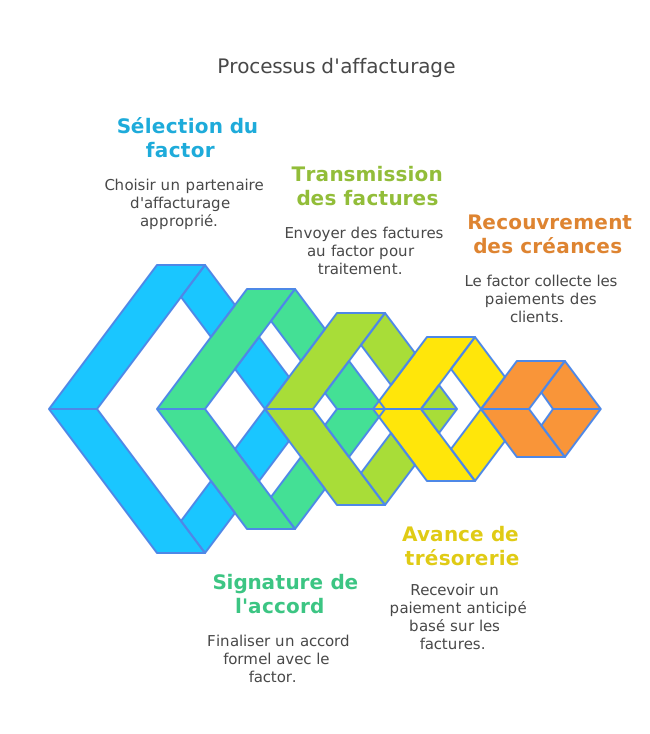
Factoring implementation process
Factoring follows a rigorous process to ensure its smooth operation.
How to choose a factoring company?
To choose the best factoring solution, it is essential to compare several criteria:
- Costs and commissions: Analyze the fixed and variable costs applied by the factor.
- Services included: Some factors offer additional services such as credit insurance.
- Contractual flexibility: Examine the conditions for terminating and modifying the terms of the contract.
- Reputation and experience: Check the factoring company’s reviews and experience.
Support from Palmer Consulting
Palmer Consulting helps companies set up an optimized factoring solution, offering :
- A financial audit to assess cash flow needs and identify factoring opportunities.
- Selection of the best factors according to the company’s criteria (cost, flexibility, additional services).
- Assistance in negotiating contracts to obtain the best terms and conditions.
- Rapid operational implementation and long-term monitoring of factoring performance.
Thanks to a tailor-made approach, Palmer Consulting helps its customers maximize the benefits of factoring while minimizing costs and maintaining good customer relations.
Conclusion: Factoring, a strategic tool for cash management
Factoring is a powerful financial lever enabling companies to improve their cash flow and protect themselves against the risk of non-payment. However, it is essential to assess the costs and implications of factoring to ensure that it is the right solution for your company’s needs. By carefully selecting their factoring partner and adopting the right strategy, companies can optimize their financing and sustain their growth.
With expert support from Palmer Consulting, companies can make the most of this solution and secure their financial management with peace of mind.