What Transformer fundamentally changes
-
Central mechanism:self-attention
→ The model “looks” at all the words in parallel and learns which relationships are important, even at long distance. -
Massive parallelization: no strictly sequential processing as in Recurrent Neural Networks (RNN ) → much faster training on Graphics Processing Units(GPU) and Tensor Processing Units(TPU).
-
Long context: handles large contextual windows (thousands of tokens), where RNN and variants lose remote memory.
-
Scale (scalability): scales very well (parameters, data, computation) → hence modern Large Language Models(LLMs).
-
Flexibility: extends to multimodal (text, image, audio), in-context learning in-context learning and efficient refinement/fine-tuning.
Limits still true on the Transformer side
-
Quadratic cost with context length (“classic” attention) → high memory and computation.
-
High data and computation requirements for very large models.
-
Less local inductive bias than Convolutional Neural Networks (CNN), which naturally capture local patterns.
Older models (and what they did)
Sequential networks
-
RNN – Recurrent Neural Networks: word-by-word processing; difficulty with long-term memory(vanishing/exploding gradients).
-
LSTM – Long Short-Term Memory: adds gates for better memory → long the state of the art in translation and speech.
-
GRU – Gated Recurrent Unit: a lighter variant of the LSTM.
-
Seq2Seq – Sequence-to-Sequence with attention (Bahdanau/Luong): the first big leap in translation;attention is a module, not the entire architecture.
Convolutions for language
-
CNN/ConvS2S – Convolutional Neural Networks / Convolutional Sequence-to-Sequence: locally parallelizable, good on local patterns, less at ease with very long dependencies.
-
(WaveNet for audio: generative convolutional architecture).
Pre-deep” statistical methods
-
n-gram models (counting language models),
-
HMM – Hidden Markov Models for sequence labeling,
-
CRF – Conditional Random Fields for structured labeling,
-
PCFG – Probabilistic Context-Free Grammars.
→ Little semantic understanding, strong feature engineering, limited performance.
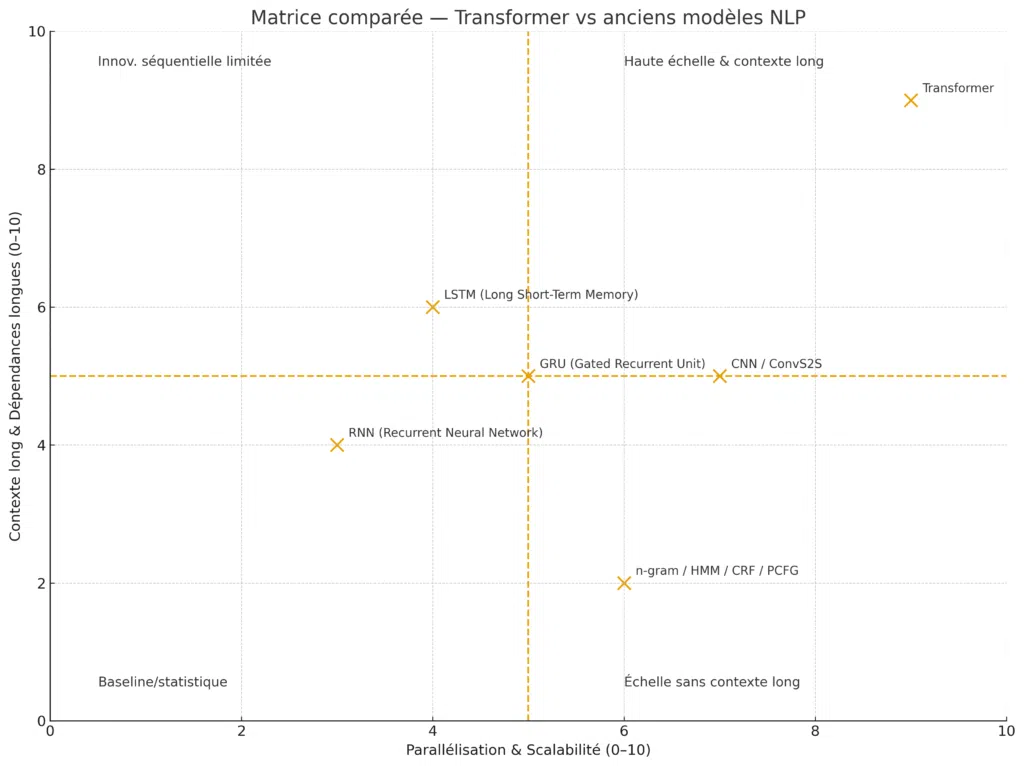
Key differences (overview)
| Dimension | Transformer | RNN/LSTM/GRU | CNN/ConvS2S | n-gram/HMM/CRF/PCFG |
|---|---|---|---|---|
| Processing | Parallel (self-attention) | Sequential (recurrent hidden state) | Local parallel (filters) | Counting/statistics |
| Long outbuildings | Excellent | Difficult (gradients) | Medium | Weak |
| Drive speed | High (GPU/TPU-friendly) | Slower | High | High |
| Long context | Large window (↑ tokens) | Limited | Limited-medium | Very limited |
| LLM Scalability | Very good | Limited | Average | N/A |
| Data requirements | High | Lower | Low | Low |
| Memory/compute cost | High (attention) | Moderate | Moderate | Low |
| Local inductive bias | Weaker | – | Stronger | – |
Or do we still prefer the old ones?
-
Strong resource constraints (embedded/edge, small datasets) → GRU/LSTM remain relevant.
-
Dominant local patterns (small sequences, regular patterns) → CNN/ConvS2S efficient, simple and fast.
-
Historical labeling pipelines (little data, need for interpretability) → CRF/HMM still useful.