Artificial intelligence
AI Agents for Crypto: Automation and Investment Strategies
The cryptocurrency market is evolving at breakneck speed. Faced with this complexity and ongoing volatility, more and more investors are turning to artificial intelligence agents specialized in crypto. These tools are no longer limited to simple execution bots; they embody a new generation of financial assistants capable of analyzing huge volumes of data, predicting trends and making decisions autonomously. This article offers an in-depth exploration of AI agents applied to the world of cryptocurrencies, from their technical operation to their practical uses, including their strategic advantages and the precautions essential for using them effectively.
Do you have a project or questions about AI? Get in touch with us!
What is a crypto AI agent?
A crypto AI agent is an autonomous piece of software designed to assist an investor or trader in managing their digital assets. Unlike traditional bots, which follow predefined, immutable rules, the AI agent continually learns from its environment thanks to machine learning. It analyzes not only prices and volumes traded on platforms, but also news feeds, trends from social networks and data available on the blockchain. This multimodal capability enables it to make decisions based on a wide variety of signals.
The typical architecture of a crypto AI agent rests on several pillars: an analysis engine based on machine learning algorithms, a prediction module responsible for anticipating price trends, a risk manager that adjusts strategies according to context, and finally an executor that places orders on the connected platforms. This system operates in a continuous loop, refining its behavior as it interacts with the market.
The emergence of AI agents in crypto finance
The use of artificial intelligence in the financial markets is nothing new. For over a decade, major institutions have been using algorithms to automate trading decisions. However, the cryptocurrency market has introduced new complexity, with extreme fluctuations, a lack of centralized regulation and round-the-clock trading volumes. This reality has accelerated the development of agents capable of processing millions of signals in real time.
While early crypto bots were limited to executing simple orders, modern AI agents are capable of spotting anomalies in blockchain transactions, identifying suspicious movements in large portfolios or even anticipating trends by analyzing investor sentiment on Twitter and Reddit. According to a 2025 PwC report, more than two-thirds of institutional funds are already using these tools, and the trend is set to continue growing as competition intensifies.
Strategic advantages for investors
The main advantage of a crypto AI agent lies in its ability to remain active without interruption. Where a human investor must sleep, an agent continuously monitors hundreds of cryptocurrency pairs and reacts instantly to variations. This permanent availability is a game-changer in a market that never closes.
Another advantage lies in the detection of weak signals. Where a traditional trader relies on known technical indicators, the AI agent cross-references this data with elements that are often overlooked: a sudden influx of messages on a social network, the massive deployment of smart contracts on a blockchain, or the unusual movements of large whale-like addresses. This approach makes it possible to anticipate trends before they become obvious to the general public.
A third major benefit is risk management. IA crypto agents don’t just seek to maximize gains; they also take care to protect capital. Thanks to dynamic stop-losses and automatic reallocation to stablecoins in the event of high volatility, they offer enhanced security. In this way, investors can limit their losses even in chaotic market conditions, which is particularly valuable in a world as unpredictable as that of cryptos.
Case studies and practical examples
Let’s take the case of an individual investor using an AI agent linked simultaneously to several platforms such as Binance, Kraken and Coinbase. The agent detects a price differential on Ethereum, buys on the cheapest platform and sells on the one with the highest price, making a profitable arbitrage in a matter of seconds. This type of operation, impossible to execute manually with such speed and precision, illustrates the added value of AI in crypto.
Another example concerns the detection of market manipulation, known as “pump and dump”. By analyzing discussions on Telegram or Discord, the agent identifies signals of a coordinated organization aiming to artificially inflate the price of a token. Rather than buying and risking a significant loss when the price falls, he can block the transaction and warn the investor.
Finally, for diversified portfolios, AI agents are able to rebalance allocations automatically. If Bitcoin falls sharply, the agent can reduce its exposure and increase that in stablecoins, thus ensuring overall capital preservation. This flexibility is similar to that of a fund manager, but with incomparable speed and responsiveness.
The main AI agent platforms for crypto
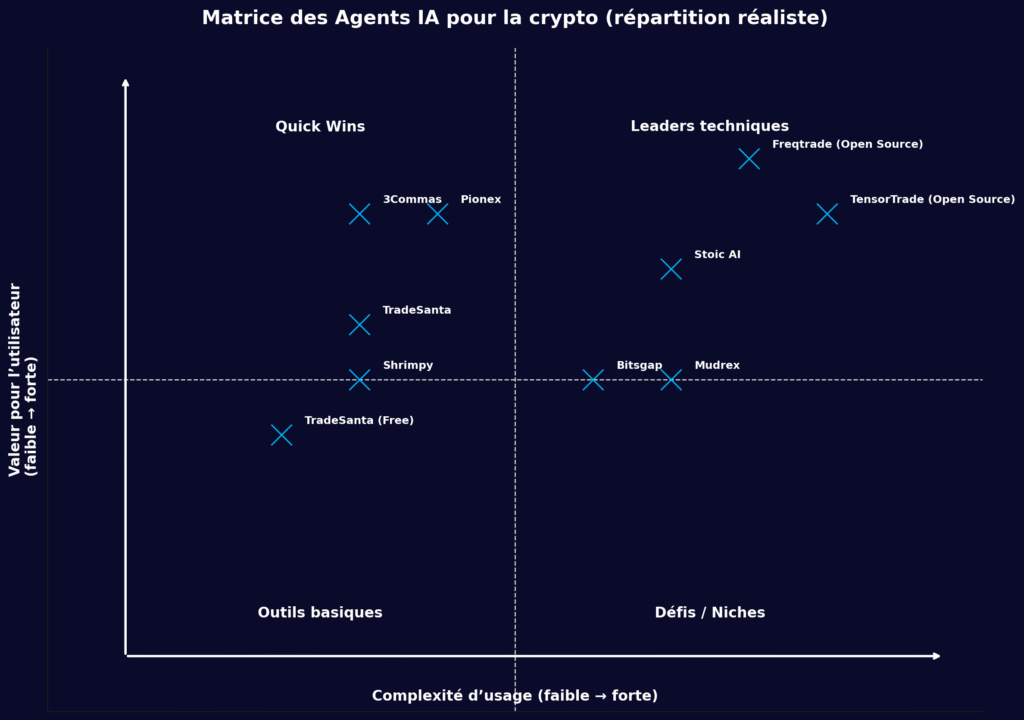
Several platforms have established themselves as leaders in this field. Among them, 3Commas stands out for its DCA and GRID strategies, which enable even novice investors to automate their orders according to evolving rules. CryptoHopper is renowned for its adaptive artificial intelligence, capable of modifying strategy according to market volatility, and also offers comprehensive backtesting. Bitsgap, on the other hand, attracts inter-exchange arbitrage enthusiasts with its intuitive interface and powerful tools.
For investors with technical skills, open source solutions such as Freqtrade or TensorTrade offer the possibility of developing tailor-made agents. These projects, available on GitHub, enable complete customization, from the integration of exchange APIs to the implementation of complex strategies based on neural networks.
| Agent IA Crypto | Strategic positioning | Key strengths | Key targets |
|---|---|---|---|
| 3Commas | Accessible automation | DCA & GRID strategies, simplicity | Beginner and intermediate investors |
| CryptoHopper | Adaptive AI | Advanced backtesting, dynamic adjustment | Traders looking for flexibility |
| Bitsgap | Inter-exchange arbitration | Intuitive interface, powerful tools | Cross-platform arbitrage fans |
| Freqtrade (Open Source) | Total customization | Custom development, API integration | Technical traders, developers |
| TensorTrade (Open Source) | AI experimentation | Neural networks, complex strategies | Data scientists, researchers |
👉 Also read : AI Agent Open Source
Risks and best practices
The use of crypto AI agents should not be considered without caution. Extreme market volatility can render even the most sophisticated models ineffective during “flash crashes”. In addition, cybersecurity is a crucial issue: providing poorly configured API access can enable hackers to hijack an account.
It’s advisable to always start with a demo account, to avoid giving APIs the ability to make withdrawals, and to regularly update the algorithms. Wise investors combine several AI agents to diversify their approaches, while retaining human supervision. Supervision remains essential, as no system, however advanced, is infallible.
Key figures and market trends
The data confirms the scale of the phenomenon. By 2025, over 500,000 individual traders are using an active AI agent for crypto. Institutional funds that adopt these tools report an average 25% higher return than those that do without. The global market for crypto AI agents, estimated at $4 billion in 2024, is expected to reach $15 billion by 2030. This growth reflects the growing importance of AI in decentralized finance and increased competition between investors.
The future of crypto AI agents
The next few years should see even greater integration of AI agents into the Web3 ecosystem. Metaverse projects, NFT platforms and next-generation decentralized finance solutions will directly integrate these agents to automate complex strategies. We can imagine agents capable of simultaneously managing a crypto portfolio, NFT assets and DAO investments, while optimizing taxation and complying with local regulation.
What’s more, the arrival of agents capable of collaborating with each other will pave the way for coordinated multi-agent systems, where several AIs will work in concert to maximize an investor’s performance. This evolution will mark a new era in automated digital asset management.
FAQ
Are AI agents replacing human traders?
No. They complement analysis and execution, but human follow-up remains essential.
What’s your budget?
On average, access to a platform costs between 20 and 200 euros per month. Open source solutions are free, but require programming skills.
Are winnings guaranteed?
Absolutely not. Even the best agents can’t eliminate market volatility. They can, however, reduce risk and improve the consistency of results.
How to get started
It is advisable to test an agent on a demo account before investing. Platforms such as Binance Academy and CryptoHopper Academy offer beginner-friendly training courses.
👉 To find out more, see AI Agent for Beginners.
Conclusion
Crypto AI agents are emerging as essential allies in the world of digital assets. Their ability to analyze complex data, learn and react in real time is transforming the way investors approach this market. However, they are not a magic solution: their effectiveness depends on careful configuration, rigorous risk management and attentive supervision.
The future of crypto trading lies in the combination of human expertise and artificial intelligence. Investors who know how to exploit this synergy will have a decisive advantage in an ever-changing environment.
To continue reading :
Autres articles
Voir toutDécouvrir
ChatGPT, Gemini and Copilot are already visiting your site: are you ready for invisible AI traffic?
Artificial intelligence
Découvrir
The ChatGPT paradox: a decisive role in conversion
Artificial intelligence
Découvrir
Towards a Search Console for AI agents? Bing leads the way with Copilot
Artificial intelligence
Voir tout