Artificial intelligence
AI and automation for a low-carbon construction industry – BTP
Publiée le October 19, 2025
Publiée le October 19, 2025
The digital transformation of the construction industry is not limited to project management and planning. It also involves the adoption of new construction processes incorporating robotics, 3D printing and off-site industrialization. These technologies, often coupled with artificial intelligence (AI), address the challenges of productivity, labor shortages and carbon footprint reduction. While some players are still experimenting, competitors such as Bouygues Construction and Vinci Construction have already delivered emblematic projects.
See our graph showing where construction companies stand in terms of AI maturity:
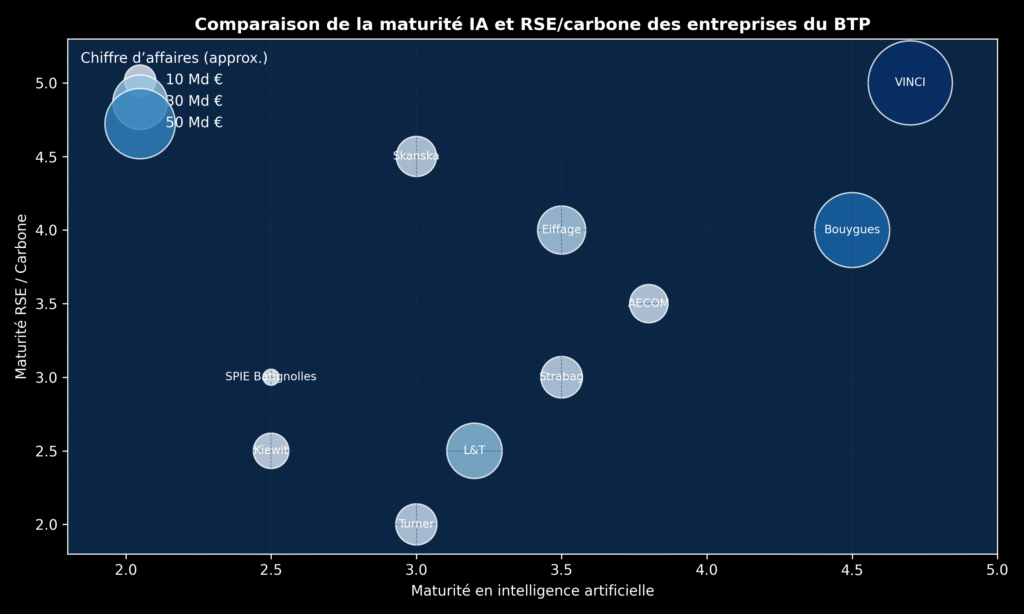
*Palmer Research based on cross-referenced data
One of the first high-profile examples of 3D printing in France is the Yhnova house, built in 2017 in Nantes. This project, led by the University of Nantes in partnership with Bouygues Immobilier Grand Ouest, used a 7-axis robot to print polyurethane walls used as formwork for a concrete slab. The world’s first occupied printed housebouygues-construction.com. This initiative demonstrated the feasibility of the process, but also revealed the need to industrialize off-site manufacturing.
In 2020, Bouygues Immobilier and Dutch start-up CyBe built ” La Sphère ” in Harfleur, a reception building whose walls were printed on site with concrete. The process saved 30% in concrete consumption compared with conventional construction, by creating very thin walls. This material saving translates into reduced purchasing, transport and CO₂ emissions.
3D printing is not limited to small-scale demonstrations. Start-ups such as XtreeE are setting up production units for printed concrete parts for facade elements, columns and footbridges. Their plants manufacture components in a controlled environment, ensuring repeatable quality and reducing the number of parts to be assembled on site. The Villaprint project, carried out for Plurial Novilia, will print walls for five single-family homes. These projects illustrate the transition to industrialization: components are printed in the factory, optimized by generative design algorithms, then assembled on site.
AI intervenes on two levels: it optimizes the shapes (variable thickness, localized reinforcements) to reduce the quantity of material, and it controls the robot’s trajectory to adapt the speed and quantity of material deposited according to the geometry. Generative design makes it possible to create biomimetic or organic shapes that would be impossible with traditional formwork, paving the way for more efficient and aesthetically pleasing buildings.
Robotization also applies to tasks that do not require 3D printing. Companies such as Larsen & Toubro use cutting robots to plan the cutting of rebar. The algorithm determines the optimum cutting lengths and reduces metal waste by several percent.
Other players are deploying autonomous robots to lay bricks and blocks. In the USA, start-ups such as Dusty Robotics and Doxel offer layout and quality control robots. Although these solutions are not yet widespread in Europe, they show that robotization of the construction industry is spreading rapidly, and that it relies on vision algorithms to find one’s way in space.
The trend towards industrialization is also visible in timber and modular construction. Vinci Construction showcases projects where components are manufactured in factories and then assembled on site. For example, the Silva tower in Bordeaux uses prefabricated timber-frame facades to reduce site time and nuisance. This off-site production method requires precise logistics that AI can optimize: transport planning, crane coordination and anticipation of weather delays.
AI also helps to map and prepare the ground. Vinci start-up Exodigo merges radar, electromagnetic wave and LiDAR data to create a map of buried networks. This technology reduces the risk of pipe damage, improves excavation planning and avoids costly site stoppages.
Earthworks also benefit from AI. GPS guidance and intelligent compaction solutions enable drivers to follow a digital plan and control the number of passes. Competing companies equip their compactors with sensors that record position and compactness to generate a 3D model of the soil. This information is used to optimize fuel consumption and guarantee foundation quality.
Georeferencing trenches is another example: a mobile application coupled with a GNSS receiver captures photos and creates a 3D point cloud. By linking this data to the BIM model, teams have precise documentation and reduce the need for topographical interventions.
Additive construction is not limited to buildings. Projects for bridges and infrastructure structures are emerging. In the run-up to the Paris 2024 Olympic Games, companies have printed concrete footbridges usingXtreeE technology. These works demonstrate that 3D printing can be applied to load-bearing structures, and that it reduces wastage of formwork and concrete.
The main benefit of these new processes is environmental. 3D printing and off-site manufacturing allow us to optimize the shape of elements, reduce scrap and work with low-carbon concrete formulations. In the La Sphère project, the 30% reduction in concrete volume shows that generative design can significantly reduce a project’s carbon footprint.
Off-site industrialization also improves employee safety and comfort by transferring arduous tasks to the factory floor. Workshops benefit from enhanced quality control and more efficient waste management.
Despite these successes, a number of obstacles remain. Standards and regulations are not yet adapted to printed structures, which slows down large-scale projects. The investments required to acquire robots and train teams are substantial. In addition, the supply chain must evolve: the supply of raw materials (powder or special concrete) and the availability of spare parts influence profitability.
AI integration also involves rigorous data collection. Teams need to learn how to model printed parts in BIM, calculate cycle times and analyze robot performance. Finally, acceptance by customers and end-users remains a challenge: they need to be convinced of the reliability and durability of these new techniques.
Innovative construction processes – 3D printing, robotics, off-site manufacturing – are transforming the construction industry. Driven by companies such as Bouygues Construction, Vinci Construction and an ecosystem of start-ups, they are optimizing forms, reducing waste and improving productivity. AI plays a central role in generative design, robot control and logistics. Despite regulatory and organizational challenges, these technologies are paving the way for more efficient, sustainable and safer construction. Players who know how to integrate them on a large scale will have a considerable competitive advantage in the race for the ecological and digital transition of the construction industry.