Artificial intelligence
AI and LLM giants: focus on Databricks
The market forgenerative AI, LLMs LLM (Large Language Models) and NLP are booming. This boom is underpinned by growing demand for intelligent tools to automate content creation, data analysis, conversational agents and the extension of business use cases (AI co-piloting, recommendation, automatic synthesis).
In this context, integrated data & AI platforms play a central role: they enable organizations to build, deploy and govern models on massive databases. This is where Databricks, a major player in the Data Intelligence Platform segment, comes in.
This article describes Databricks in detail: its business, technology model, fundraising, customers and strategic positioning.
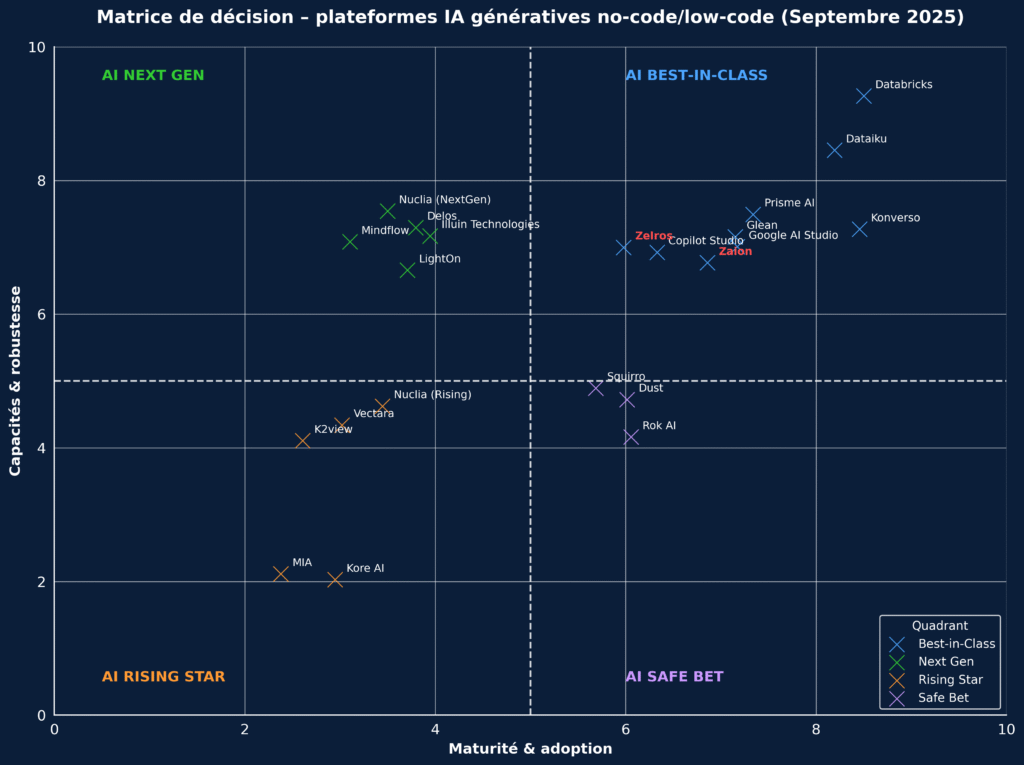
Databricks
Overview: business and expertise
Founded in 2013 by the creators of Apache Spark, Databricks is an American software company based in San Francisco. Its mission: to simplify access to data and AI for businesses via a unified platform for data, analytics and artificial intelligence.
Databricks’ core approach is based on the lakehouse concept – an architecture combining the advantages of data warehouses and data lakes – to enable analysis, machine learning, streaming and governance on a single platform.
Databricks offers tools for :
-
data engineering / ETL,
-
SQL analysis and business intelligence,
-
machine learning and AI (training and deploying models),
-
data governance and cataloguing (Unity Catalog, Delta Lake).
Today, Databricks presents itself as a “data intelligence platform powered by generative AI” to help companies become data- and AI-driven.
Technological openness: open source vs. proprietary
Databricks adopts a hybrid model between proprietary and partial openness.
Open source contributions:
The company is behind a number of major projects: Apache Spark, Delta Lake, MLflow, Apache Iceberg. These initiatives give the company a strong credibility in the open source ecosystem.
Proprietary technologies:
Certain differentiating bricks, such as Unity Catalog or certain Delta Lake extensions, are offered within a proprietary framework. This enables Databricks to ensure performance, security and premium integrations, while maintaining compatibility with open standards.
Databricks strikes a balance between open-source credibility and proprietary differentiators.
Fundraising, founders and investors
Founders:
Databricks was founded by Ali Ghodsi, Matei Zaharia, Ion Stoica, Andy Konwinski, Patrick Wendell, Reynold Xin and Arsalan Tavakoli.
Financing :
-
November 2024: USD 10 billion Series J, valued at USD 62 billion, led by Thrive Capital and Andreessen Horowitz.
-
At the same time: USD 5.25 billion in debt.
-
In total: almost 15.7 billion USD raised since its creation.
-
Rumours at the end of 2025: a Series K aimed at a valuation in excess of 100 billion USD.
These massive financings testify to investors’ confidence in Databricks’ central role in AI and data.
Current customers
Databricks boasts over 10,000 customers in various sectors (finance, industry, retail, healthcare, tech).
Notable examples:
-
London Stock Exchange Group (LSEG), strategic partnership to integrate AI into finance and risk analysis.
-
Deep integration with Microsoft Azure (Azure Databricks), enabling large enterprises to easily adopt its solutions in a secure environment.
-
Many Fortune 500 companies use Databricks for their data/IA projects.
Databricks has also invested in startups, such as Indicium in Latin America, to expand its geographical presence.
Market positioning and differentiation
Competitive advantages :
-
Unified platform covering the entire data → AI chain.
-
Lakehouse architecture: flexibility and enhanced governance.
-
Recognized open source (Spark, Delta Lake, MLflow).
-
Continuous innovation: Agent Bricks, Lakehouse AI, etc.
-
Strategic partnerships with Microsoft Azure.
-
Compliance and sovereignty through tailored cloud options.
Differentiation:
Databricks is positioned as a hybrid solution:
-
Open, thanks to its open source contributions.
-
Differentiation, through premium proprietary modules.
In Europe, Azure Databricks also addresses the growing issue of data sovereignty.
Conclusion: trends and outlook
Databricks embodies the market tension between open source and proprietary technology.
-
Open source models are on the advance, and their transparency is winning them over.
-
But companies often prefer hybrid solutions that offer both portability and premium support.
The rise of European (Mistral, LLaMA) and Chinese (DeepSeek) players is diversifying the competition against American giants such as Databricks, OpenAI and Google.
Finally, the move towards agentic platforms (such as Agent Bricks) shows the trend away from simple data processing towardsautonomous, actionable AI, where governance and scalability will be the keys to success.
Sources
Autres articles
Voir toutDécouvrir
ChatGPT, Gemini and Copilot are already visiting your site: are you ready for invisible AI traffic?
Artificial intelligence
Découvrir
The ChatGPT paradox: a decisive role in conversion
Artificial intelligence
Découvrir
Towards a Search Console for AI agents? Bing leads the way with Copilot
Artificial intelligence
Voir tout