Artificial intelligence
AI for project management and BIM – BTP
Publiée le October 19, 2025
Publiée le October 19, 2025
The digital transition in the construction industry is no longer limited to 3D modeling; it is being enriched by artificial intelligence (AI) solutions that enable projects to be planned, monitored and optimized. While some companies are content to test isolated tools, players such as Bouygues Construction, Vinci Construction, Strabag SE and Turner Construction have made AI a central lever for controlling deadlines, costs and quality. This development is a response to the problems observed among many competitors: schedule drift, difficult team coordination and data fragmentation.
AI maturity matrix for construction companies :
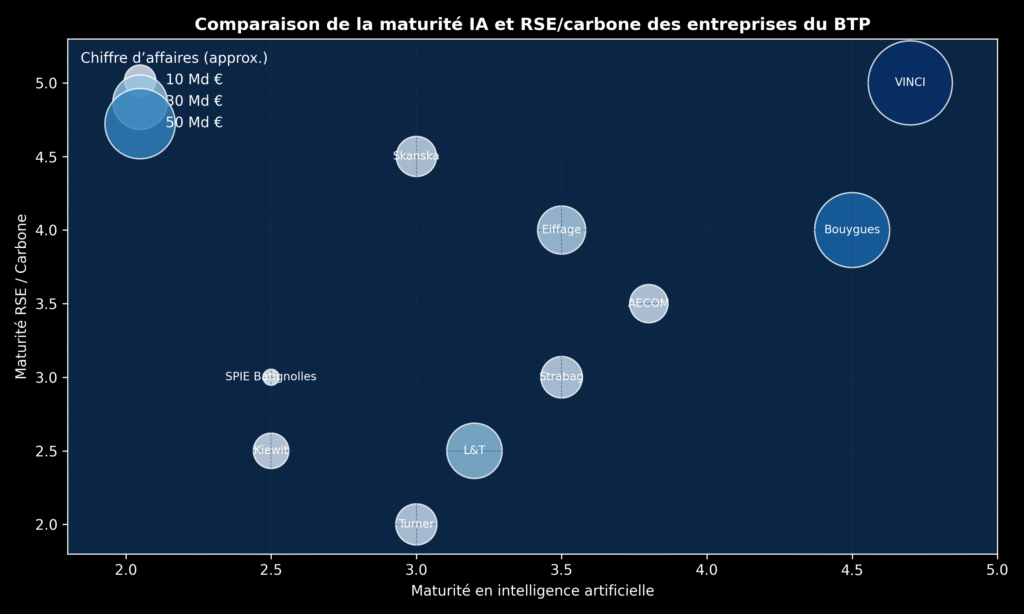
*Palmer Research based on cross-referenced data
Building Information Modeling (BIM) has paved the way for digital collaboration by providing a shared model of the project. However, construction giants are going one step further by integrating planning algorithms. Bouygues Construction has adopted the ALICE Technologies platform, which leverages AI to generate millions of execution scenarios. At a metro station in Bagneux, these simulations enabled the redesign of a retaining wall, saving 140 tons of steel.bouygues-construction.com. ALICE tests different team sizes, shift durations and task sequences to find the fastest and least expensive plan.
These simulations are not just for design purposes. During construction of the Colne Valley Viaduct on the HS2 high-speed line in the UK, the Align consortium (which includes Bouygues) used ALICE to assess the benefits of adding a second footing installation team. The AI showed that this option increased “buoyancy” without lengthening the schedule. The solution is also used to test the impact of a second TBM on underground projects; these analyses directly influence resource mobilization and equipment selection.
Beyond planning, AI is transforming site monitoring. Vinci Construction deploys site capture tools like OpenSpace and Buildots. OpenSpace uses 360° cameras to record images during site visits. AI synchronizes these images with the BIM model and deduces progress. This system has saved Vinci over 5,200 man-hours on 25 projects in the UK. Buildots, meanwhile, combines helmet-mounted cameras with an AI that compares what is being built with what is planned. On a project in Sweden, this tool increased task completion rates by 230% and reduced reporting time by 70%. This objective data strengthens coordination between the worksite, the design office and the customer.
The integration of BIM with operational data also paves the way for digital twins. In an analysis published by Leonard, Vinci’s foresight unit, the digital twin is presented as a living avatar that optimizes a building’s performance throughout its lifecycle. In particular, it can be used to adjust energy consumption, enhance safety and implement predictive maintenance. The Building Operating System (BOS), which combines BIM data with occupancy, temperature and air quality sensors, offers contextual, self-learning services.
Contractual documents are an important part of project management. Vinci Construction is developing AI applications to analyze clauses and identify those that present risks. The tool examines public tenders to detect opportunities and help sales teams react quickly. It also generates technical file templates to free up engineers’ time.
For their part, teams atEquans (a Bouygues subsidiary) are testing LegalAize, an application designed with Amazon Web Services to help analyze and classify contracts using AI. Meanwhile, start-ups like Mastt offer portfolio management platforms that automate reporting, forecast risk and centralize budgets. These tools are transforming the daily lives of project managers, who can concentrate more on value-added tasks.
The digital twin doesn’t stop at construction. In the operational phase, it can monitor performance and anticipate failures. Vinci’s “Building the future” report notes that AI is already being used to analyze machine signals and identify faults before they become visible. GNSS data and vision algorithms detect anomalies on roads and generate digital work plans, facilitating monitoring and maintenance.
Start-ups like Deepki offer property owners AI-based “virtual retrofits”. The platform simulates the impact of energy renovation on consumption and emissions, helping to define the most cost-effective actions and track progress in real time. These tools are gradually being integrated into operating systems to offer predictive asset management.
The advent of AI in project management hinges on the ability to collect and share data on a large scale. Strabag SE has set up a centralized data hub, supported by Microsoft, which connects all its entities and enables the development of use cases such as risk forecasting. The group points out that the culture of the construction industry often hinders the sharing of information, but that governance rules need to be established to enable all sites to contribute to and consume data. Similarly, Bouygues’ DataLab is extending its activities beyond tunnels to include nuclear power plants, offshore wind farms and civil engineering sites; the variety of projects reinforces the importance of generic models and shared learning.
China State Construction deploys 5G-connected “smart” construction sites that analyze in real time the presence of personal protection and entry into prohibited areas. AI compares camera images with 3D models to check quality and facilitate remote inspections.
Turner Construction uses the CraneView sensor developed by Versatile. Mounted on crane hooks, it records each lift and classifies loads. On the Manchester Pacific Gateway site in San Diego, the tool was used to detect idle time and reconfigure crews, enabling a machine to be withdrawn earlier than planned.
STRABAG uses AI to predict delays and costs right from the design phase by comparing new projects with thousands of past projects, integrating external data (weather, logistics) to offer 80% accuracy.
Despite these advances, several challenges remain. Data quality and standardization are essential if algorithms are to deliver reliable results. Leonard’s experts point out that BIM must be accompanied by an effort to collect field data and a common nomenclature. Without this, updating the digital twin and comparing projects is complicated.
Organizational culture is another obstacle: AI sometimes arouses mistrust among teams, as Strabag’s managers explain, who have to carry out awareness-raising actions to reassure employees. Finally, cybersecurity becomes crucial, as integrated tools and sensitive data (contracts, plans, site photos) need to be protected.
Digital project management is undergoing a metamorphosis thanks to AI. By combining BIM with simulation platforms, visual capture systems and predictive algorithms, construction leaders are improving planning, reducing contingencies and enhancing construction quality. These solutions are more than just digitization: they establish a holistic approach that links design, execution and operation. Ultimately, the challenge will be to integrate these tools seamlessly, train teams and foster a culture of data sharing so that AI becomes an everyday partner rather than an experimental gadget.