Artificial intelligence
AI in the construction industry
Publiée le October 19, 2025
Publiée le October 19, 2025
While the building and civil engineering sector has been slower to digitize than other industries (such as automotive or aeronautics), the trend has been reversed over the past five years. The health crisis, pressure on materials costs and the scarcity of labor have accelerated the adoption of digital and intelligent solutions.
Today, the convergence of BIM (Building Information Modeling), IoT sensors, computer vision, robotics and machine learning is creating an ecosystem conducive to the massive exploitation of data. This previously dormant data is now being leveraged to anticipate, optimize and automate.
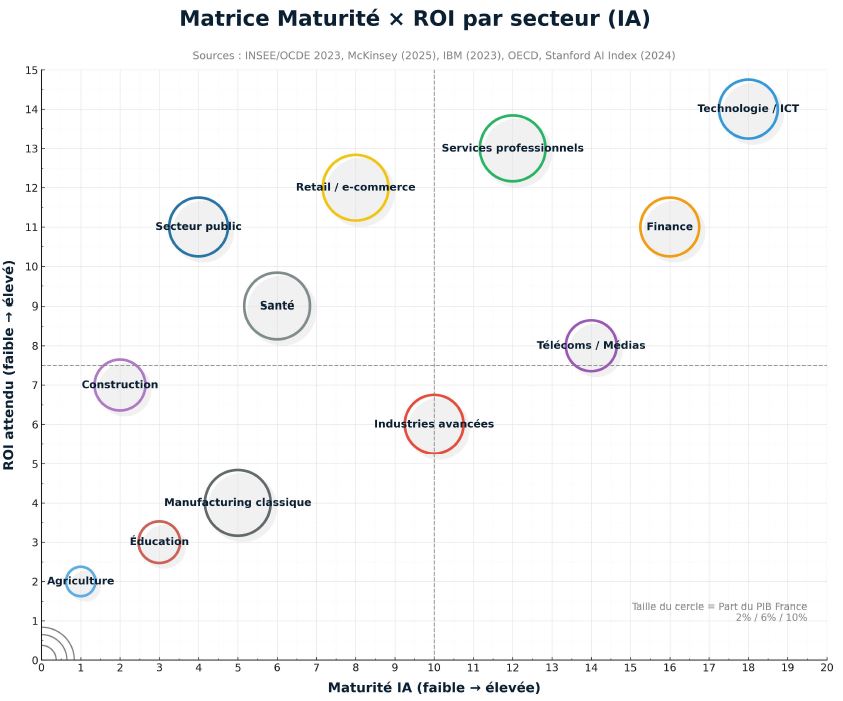
In this sense, AI acts as a digital orchestra conductor: it links the various tools and trades of the construction industry to streamline interactions and transform the worksite into a real-time decision-making platform. The building and civil engineering sector is among those lagging furthest behind in the adoption of AI (Construction of the matrix below):
From the earliest stages, AI is revolutionizing the way in which projects are designed and organized.
Thanks to generative algorithms, it is now possible to create optimized architectural or structural plans based on multiple constraints: cost, solar orientation, energy performance, traffic flow, fire safety…
Software based on Generative Design (such as Autodesk Spacemaker) automatically generates hundreds of design variants in a matter of seconds, enabling engineers to choose the most efficient solution.
AI-enhanced BIM detects inconsistencies between architect, electrician or structural plans in real time, avoiding costly errors on site.
Predictive models anticipate the risk of delays, cost overruns or quality defects based on historical data from similar projects.
In short, planning becomes predictive rather than reactive.
In the field, AI is changing the game. Modern construction sites are now packed with IoT sensors, 360° cameras, drones and even autonomous robots.
These devices feed AI models capable of :
Compare actual and theoretical progress on a site in real time (thanks to computer vision).
Automatic detection of safety anomalies: absence of helmet, poor signage, unmarked danger zone.
Analyze the productivity of site machinery and optimize its trajectory or energy consumption.
Track materials and anticipate supply shortages with predictive logistics systems.
Some startups, such as Buildots, use cameras worn by workers to digitize the site as they go. The images are analyzed by AI and compared with the BIM model to identify discrepancies. The result: an average 15% improvement in lead times and a 25% reduction in errors.
Once the building has been delivered, artificial intelligence continues to generate value.
Connected buildings equipped with sensors continuously transmit data on temperature, humidity, energy consumption or structural vibration. This information feeds predictive models capable of :
Anticipate equipment breakdowns (elevators, boilers, electrical systems) before they happen.
Optimize maintenance to reduce costs and extend plant life.
Automatically adjust energy parameters according to actual building occupancy.
The concept of the Digital Twin is revolutionary here: a virtual copy of the building, constantly updated, enables interventions to be simulated and optimized in real time.
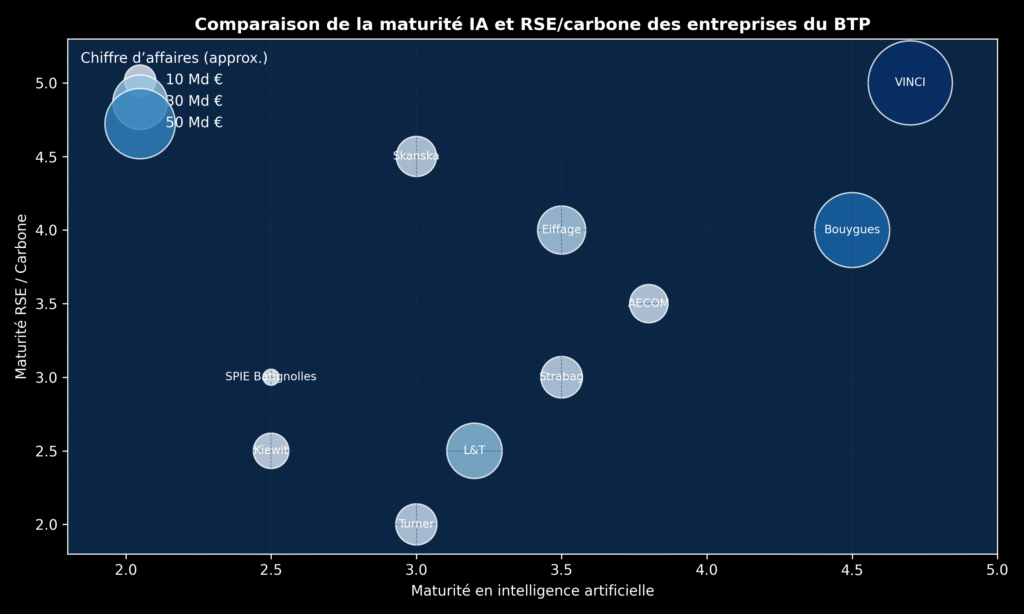
As European leader, VINCI integrates AI into its worksite management platforms (VINCI Energies, Leonard). The group uses predictive models to optimize infrastructure maintenance and automatic fault detection systems on its networks.
The group has relied on computer vision and augmented BIM to monitor the progress of construction sites. The aim is to reduce the cost of design errors by 20% by 2027. Bouygues is also working on carbon modeling of materials to achieve carbon neutrality by 2050.
Eiffage is investing in intelligent robotization andembedded AI solutions for bridge and tunnel maintenance. The company is also experimenting with AI for the automatic planning of human resources on worksites.
The group relies on the digitization of data flows to develop concrete AI uses: image recognition for quality control, predictive analysis for cost monitoring, or even energy optimization of delivered buildings.
Artificial intelligence is not limited to operational optimization; it is becoming a strategic tool for decarbonizing the sector.
AI makes it possible to model the carbon footprint right from the design stage of a project, and to steer the choice of materials towards low-carbon solutions (recycled concrete, wood, raw earth, etc.).
Algorithms identify areas of energy waste on a construction site or in a building in operation.
Predictive waste management systems optimize sorting and reuse.
At the same time, manufacturers are increasingly integrating CSR (Corporate Social Responsibility) criteria into their AI strategy, particularly with regard to worker safety and the reduction of environmental pollution.
The sector’s dynamism also comes from start-ups specializing in artificial intelligence applied to construction:
Dusty Robotics (United States): AI-guided autonomous floor marking robots.
Buildots (Israel): automatic progress monitoring using cameras and BIM.
Versatile.ai: sensors installed on cranes to measure productivity.
OpenSpace.ai: automatic 3D mapping of the worksite in real time.
Spacemaker (Autodesk): algorithmic design of buildings according to multiple criteria (ventilation, sunlight, noise, density).
These startups are imposing a data-driven approach to construction, based on precision, traceability and prediction.
To measure the maturity of construction industry players in adopting AI, several objective criteria can be used:
| Criteria | Description | Key indicator |
|---|---|---|
| 1. Strategic vision | Integration of AI into overall corporate strategy | Existence of a 3-5 year AI plan |
| 2. Governance & data | Data management and quality of digital governance | Data lake, cybersecurity policy |
| 3. Process automation | Level of AI integration in operations | of sites equipped with AI tools |
| 4. Training & skills | Acculturation of teams, data training | Number of hours of AI training/year |
| 5. Innovation & partnerships | Cooperation with startups, laboratories, universities | Number of collaborative projects |
| 6. Measurable impact | Concrete gains in productivity, safety, environment | Reduced costs, lower emissions |
| 7. Ethics & sustainability | Respect for privacy, RGPD compliance, responsible use | IA Ethics Charter adopted |
Tomorrow’s construction sites will be fully connected, collaborative and autonomous.
Operational decisions will be taken in real time thanks to self-learning algorithms, while digital twins will evolve in parallel with the physical world.
The site foreman will become an augmented conductor, steering flows of information, robotics and energy. Buildings, for their part, will be able toself-regulate their consumption and interact with urban infrastructures to optimize resources.
Artificial intelligence doesn’t replace humans: it relieves them of repetitive tasks, allowing them to concentrate on creativity, safety and sustainability.
AI is emerging as the driving force behind the transformation of the construction industry.
It reinvents trades, optimizes performance, enhances safety and contributes to the sector’s ecological transition.
Companies able to integrate AI strategically, ethically and sustainably will be the leaders of tomorrow’s construction – smarter, safer and greener construction.