Artificial intelligence
Automate private banking back-office
Publiée le October 21, 2025
Publiée le October 21, 2025
Private market operations (private equity, private debt, real estate) generate a considerable volume of documents: calls for funds, distributions, legal notices, quarterly reports, subscription contracts, tax K-1s. These documents, often in PDF format and unstructured, need to be collected, read, filed, entered into the tracking tool and shared with clients or managers.
Automated collection: Canoe Connect automates document retrieval from over 500 General Partner (GP) portals and mailboxes. The system tracks missing documents via real-time dashboards and classifies them as they are found. Canoe boasts over one million documents processed per month and more than 500 active connections, illustrating the scalability of its platform.
Extraction and structuring: Hyperscience, Magic Quadrant 2025 leader in Intelligent Document Processing, transforms documents into ready-to-use data using machine learning and optical recognition models. Eigen/Sirion offers no-code capabilities for extracting information from complex contracts and other financial documents. These solutions significantly reduce the need for double-entry and improve data accuracy.
Standardization and checks: after extraction, the data is validated by automatic rules (sum, date and consistency checks) and enriched (calculation of called-up capital percentages, distribution rates). Exceptions are sent to an analyst for correction.
Integration: standardized data feed portfolio systems (PMS/IBOR), CRMs and tax reporting tools. Thanks to standard APIs, data re-entry is avoided and data consistency is guaranteed.
Search and document RAG: all reports and contracts are indexed for semantic search. Advisors can ask questions (“What is the IRR rate of fund X?”) and obtain an answer with a quote from the original document.
Time savings and reliability: automation reduces document processing time by 50-70%. Platforms identify and standardize data from millions of documents, reducing human error and speeding up the distribution of information to customers.
Transparency: extraction logs facilitate audits and demonstrate traceability of operations.
Scalability: the ability to handle massive volumes means that new funds or customers can be integrated without recruiting proportionately more staff.
Canoe Intelligence: pioneer in document automation for private markets; the platform covers data collection, extraction and delivery, and is adopted by over 425 customers worldwide. Its new Canoe Labs division accelerates the development of AI functionalities for alts (interactive reports, fund comparisons).
Hyperscience: recognition by Gartner in 2025 underlines the platform’s excellence in transforming documents into AI model-ready data. Hyperscience also offers redaction of sensitive information (PII) and native integration with RAG solutions.
Sirion/Eigen: following the acquisition of Eigen, Sirion offers an “AI Studio” combining extraction and contract management. Almost half of the world’s systemic banks use this technology.
Asset managers and asset servicing companies are already using these solutions. For example, insurance companies such as BarmeniaGothaer and family offices have chosen Canoe to automate the collection and extraction of alts documents. Swiss and American private banks use Hyperscience or Eigen to make their document flows more reliable.
Diagnosis: identify document types (cash calls, notices, K-1s, invoices) and estimate annual volume. Identify integration points with PMS and CRM.
Choice of solution: select a tool or combination of tools (Canoe for data collection, Hyperscience for extraction, in-house RAG for research). Ensure that the supplier complies with European data storage requirements.
Pilot: launch a pilot with a few funds and measure the gains (time, accuracy, team satisfaction). Adjust processes based on feedback.
Industrialization: extend automation to all funds and integrate new modules (tax extraction, RAG). Train teams to use the platform.
The alternative asset revolution requires a transformation of the banking back-office. Thanks to Intelligent Document Processing solutions and end-to-end automation, banks can free their teams from repetitive tasks, enabling them to add real value in advising and selecting investments. Market players such as Canoe, Hyperscience and Sirion/Eigen are demonstrating that this transformation is already underway, and that the gains are significant.
Discover our ranking of the most AI-advanced private banks in Europe :
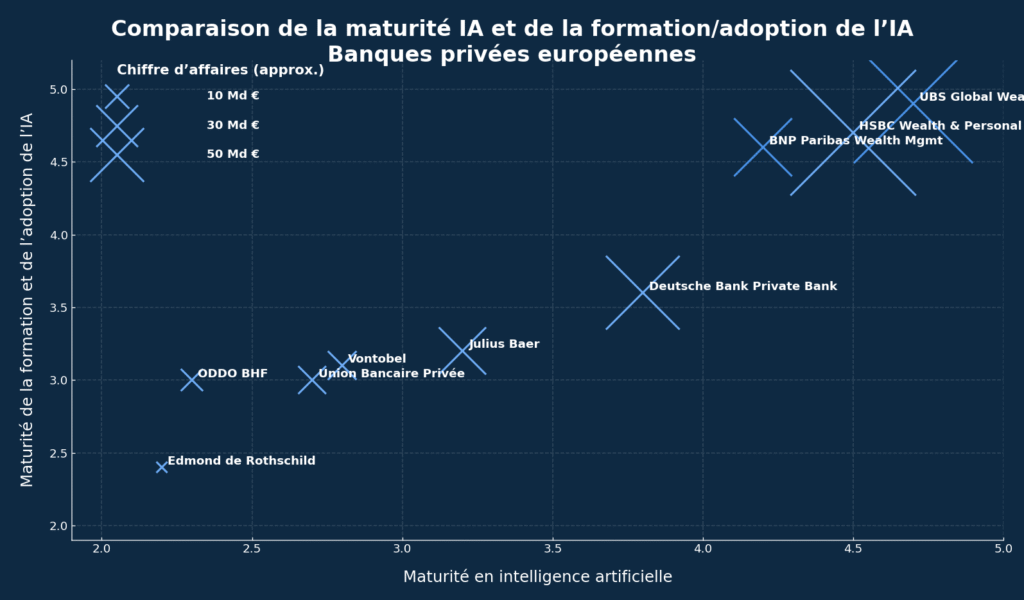
*Palmer Research Ressources (Estimated positioning based on public data) :
Horizontal axis (abscissa): Maturity in artificial intelligence.
This is a qualitative score (scale type 1 to 5, displayed here ~2 to 5) that synthesizes the technical level: data governance, models in production, AI tools (RAG, NLP, vision doc), IS integrations, security/RGPD, etc.
→ The further to the right, the more technically advanced the bank is in AI.
Vertical axis (ordinate): Maturity of AI training and adoption.
Another qualitative score (same type of scale) that measures actual diffusion in teams: training of advisors and support functions, usage rates, change management, processes, compliance checks, etc.
→ The higher you go, the more AI is used and mastered by teams.