Artificial intelligence
Building an AI copilot for private bankers with PALMER – Banque Privee
Publiée le October 21, 2025
Publiée le October 21, 2025
Private banking advisors are overwhelmed by regulatory requirements (MiFID II, RGPD requirements and French and German laws), macroeconomic analysis and the growing demand for personalization.
By 2025, competitors have already deployed AI assistants for advisors. Morgan Stanley uses a generative assistant to take notes, summarize Zoom meetings and generate follow-up emails, freeing advisors to focus on customer interactions (morganstanley.com). UBS has built “UBS Red”, an Azure OpenAI-based platform to query 60,000 regulatory and commercial documents to provide multilingual responses in real time, while BNP Paribas Wealth Management is already automating certain onboarding and reporting steps thanks to AI (group.bnpparibas). Faced with this context, the bank needs to equip its bankers with a secure, multilingual AI co-pilot.
Maturity ranking of European private banks :
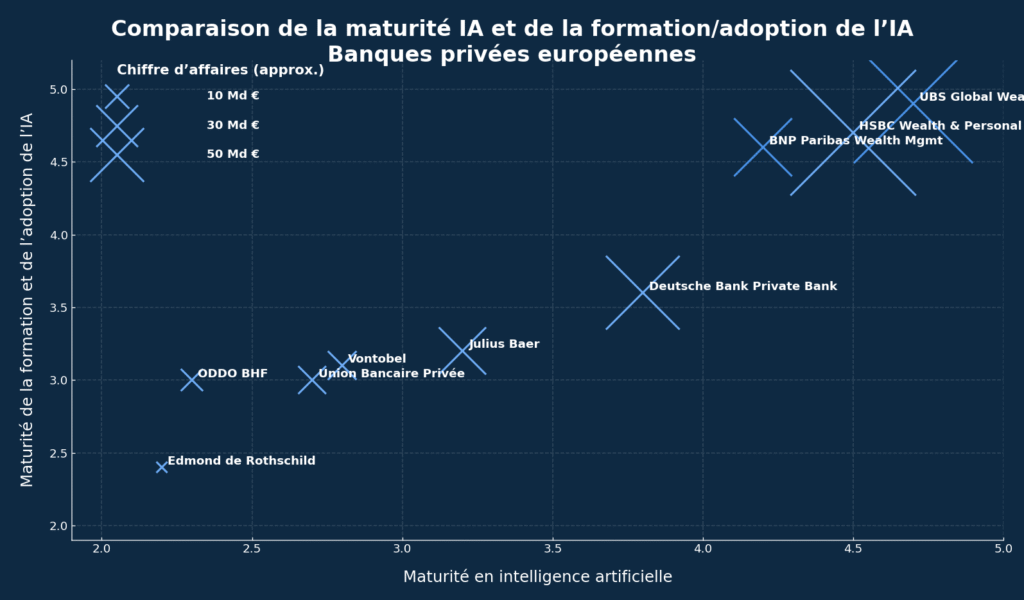
*Palmer Research Ressources, (Estimated positioning based on public data):
Horizontal axis (abscissa): Maturity in artificial intelligence.
This is a qualitative score (scale type 1 to 5, displayed here ~2 to 5) that synthesizes the technical level: data governance, models in production, AI tools (RAG, NLP, vision doc), IS integrations, security/RGPD, etc.
→ The further to the right, the more technically advanced the bank is in AI.
Vertical axis (ordinate): Maturity of AI training and adoption.
Another qualitative score (same type of scale) that measures actual diffusion in teams: training of advisors and support functions, usage rates, change management, processes, compliance checks, etc.
→ The higher you go, the more AI is used and mastered by teams.
Source collection and governance: bring together compliance policies, Chief Investment Officer (CIO) notes, product sheets, tax and CRM documentation in a data lake structured by “Wealth” taxonomy. Each document is tagged according to confidentiality (personal data or not) and language.
Generative Augmented Search (GAS ): index this content in a vector database (e.g. Pinecone or Weaviate). Advisor queries are transformed into vectors; a generative model (hosted in Europe to comply with RGPD) returns answers with citations to source documents. Internal and regulatory policies (MiFID II, suitability test, ESRS) act as safeguards to avoid inappropriate recommendations.
Language and tone management: the platform must generate responses and summaries in French, German and English. UBS demonstrates the benefits of multilingualism in its own platform.
Data protection: filtering of sensitive input data (masking of identifiers) and classification of output to prevent inadvertent disclosure. Logging for complete auditing.
Human loop: the advisor retains final responsibility. AI-generated reports, e-mails or meeting notes are always validated by the banker before being sent to customers.
Regulatory questions: an advisor asks, “Can I offer EUROD stablecoin to this customer?” The co-pilot provides a summary of MiCA rules and product eligibility requirements.
360° customer summary: automatic synthesis of past interactions, portfolio, family projects, and suggested actions (currency rebalancing, illiquid asset arbitrage).
Generate documents such as minutes of meetings, internal memos or e-mails, adapting the level of detail and language to the audience.
Personetics: the personalized insights platform equips over 150 million banking customers and delivers 1.2 billion insights monthly. It enables the integration of behavioral alerts and proactive recommendations into private banking applications.
Eigen Technologies / Sirion: their no-code document extraction technology, used by banks such as Goldman Sachs and ING, deciphers complex contracts and feeds structured data into models.
Hyperscience: recognized as a leader in the Magic Quadrant 2025 for Intelligent Document Processing, this platform transforms documents into data ready for generative models.
Morgan Stanley: its AI assistant “AI @ MS Debrief” notes meetings, summarizes and creates follow-up emails morganstanley.com. The massive use of the tool by advisors is a good indicator of the acceptance of AI solutions in private banking.
UBS: in partnership with Microsoft, UBS has indexed over 60,000 documents to offer multilingual natural language search to its advisors microsoft.com.
BNP Paribas Wealth Management: the bank uses AI to analyze the financial press, assist managers and generate allocation proposals, while maintaining advisor centrality.
Scoping (0-3 months): map data sources, identify compliance gaps and select a vector database provider. Set up an ethics and governance committee.
Prototype (4-6 months): build a POC RAG with a limited corpus (internal policies, CIO notes); test the relevance of responses and compliance with MiFID/MiCA rules.
Pilot (7-9 months): deploy the tool to a pilot group of 20 advisors. Measure uptake, time savings and accuracy. Gather feedback to refine the model and interface.
Extended deployment (10-12 months): train all teams, integrate new sources (KYC, tax), and set up a feedback system to continuously improve AI.
Statistics from 2025 show that the adoption of cognitive assistants and content generation tools is no longer reserved for the big banks. A Temenos/Hanover Research survey of over 400 financial institutions reveals that 11% of banks have already deployed genAI solutions and 43% are in the process of implementing them; institutions with over $250 billion in assets are the most advanced (bankingjournal.aba.com). The main motivations are improving the customer experience (64%), enhancing customer service (58%) and internal productivity (55%).
In wealth management, North American family offices are also accelerating. The North America Family Office Report 2025 shows that three times as many offices are using AI as in 2024, and that 29% are adopting generative models to automate investment reports, while 30% are using them for research. Automated investment tools are used by 69% of offices to gain efficiency, compared with 46% the previous year. Executives surveyed point out that genAI frees up time for high value-added tasks, while requiring rigorous risk and cost management source:prnewswire.com).
Consumers, for their part, are keen on personalized experiences:Accenture ‘s Banking Consumer Study 2025 indicates that 72% of customers choose their bank on the basis of personalization, but only 3% actually use the tools on offer. This gap illustrates the importance of customer education and clear communication on the benefits of new services. These trends confirm that the AI co-pilot envisaged by the bank is part of a market dynamic where competition and customer expectations are driving the rapid adoption of generative solutions.
The launch of the EUROD stablecoin in 2025 illustrates the innovative ambitions of ‘private banking institutions. To support advisors in the face of this growing complexity, the implementation of a multilingual AI co-pilot, anchored in a RAG architecture and reinforced by document extraction and personalized insight solutions, appears unavoidable. The experiences of Morgan Stanley and UBS show that an AI assistant improves efficiency without replacing human expertise. By adopting a responsible approach and putting the banker at the center, the house can combine innovation with compliance with regulatory requirements.