Artificial intelligence
Energy and environmental performance and AI – Construction
Publiée le October 19, 2025
Publiée le October 19, 2025
The construction sector is responsible for around 40% of global CO₂ emissions, mainly during the building operation phase. The energy and climate transition therefore requires us to rethink the design, operation and maintenance of structures. While some players are struggling to scale up, competitors such as Vinci Construction, Bouygues Construction and Strabag SE are investing heavily in artificial intelligence, notably through solutions forAI in construction and energy optimization solutions. These initiatives help to reduce consumption, extend the life of structures and better manage carbon footprints throughout the lifecycle.
Discover our ranking of the most advanced AI companies in the construction industry :
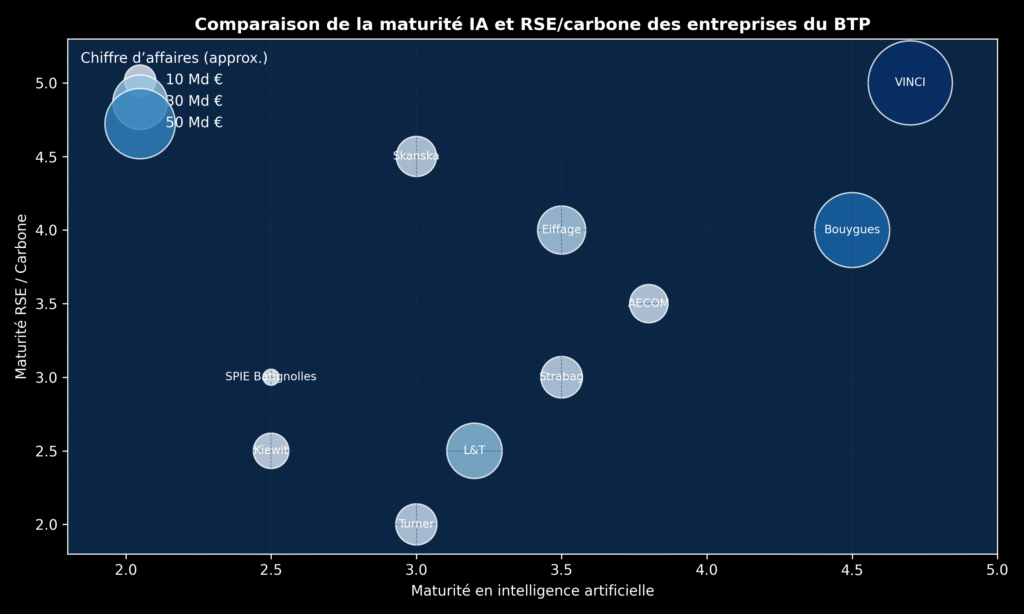
*Palmer Research
The key to energy optimization lies in precise knowledge of the building and its uses. Vinci, via its Leonard innovation structure, explains that the digital twin acts as a living avatar of the building. It combines the BIM model, materials data, thermal and acoustic characteristics, and is enriched by real events (occupancy, maintenance, incidents). This approach not only simulates construction, but also optimizes energy performance and safety throughout the building’s lifecycle.leonard.vinci.com.
To take this a step further, the Building Operating System (BOS ) combines the digital model with occupancy, temperature, air quality and room reservation data to provide contextual, self-learning services.leonard.vinci.com. This system compares occupant needs with technical parameters in real time to adjust HVAC systems, lighting and equipment. In the future, these platforms could integrate consumption prediction algorithms based on user behavior and the weather, and order corrective actions to maintain optimal comfort while minimizing consumption.
AI also plays a crucial role in maintenance. In its “Building the future” report, Vinci Construction notes that its AI solutions analyze equipment signals and identify failures before they occurvinci-construction.com. The algorithms compare vibrations, temperatures and currents with pre-trained models and trigger targeted interventions. This type of predictive maintenance can be applied to elevators, heating systems, bridge structures or water networks, and helps reduce operating costs and the risk of accidents.
Beyond buildings, some projects integrate GNSS sensors and algorithms to analyze pavement conditions, detect cracks and generate digital work plans.vinci-construction.com. By coupling this data with weather forecasts, it is possible to plan interventions at the most opportune moment to limit deterioration and optimize resources. AI is also used to predict water inflows in sewage networks or flooding in ponds, so that pumps and valves can be managed proactively.
The majors are working with start-ups specializing in data mining for decarbonization:
Deepki offers a sustainable performance monitoring platform for real estate assets. It centralizes technical and financial data and enables AI-assisted virtual retrofits to assess the impact of improvement actions on consumption and emissions.deepki.com. Decision-makers can test different scenarios (insulation, equipment renewal, photovoltaic installation) and visualize potential savings before launching work.
Mastt provides predictive dashboards that warn of cost and consumption driftsmastt.com. Thanks to AI, the platform identifies the variables that most influence performance and suggests corrective actions. It integrates energy production, water consumption and emissions data to monitor alignment with carbon targets.
Comfort control start-ups: several solutions, such as Spinalcom or Discern (cited by Leonard), analyze thousands of measurement points in buildings to automatically adapt ventilation, heating and lighting systems.leonard.vinci.com. The enhanced BOS improves occupant comfort and reduces energy costs by adapting to actual use.
The energy transition is reflected in the increasing integration of renewable energies on sites. Projects for wind farms or solar power plants require fine-tuned management of production, storage and injection into the grid. AI plays the role of conductor: it predicts production according to the weather, adjusts building consumption to use local energy and, if necessary, stores electricity or feeds it back into the grid.
For the Fécamp offshore wind farm, for example, Bouygues Travaux Publics analyzed the position and operating time of cranes to avoid saturation and optimize the use of resources.bouygues-construction.com. This approach can be applied to turbine maintenance systems, by anticipating interventions before breakdowns occur and adapting the use of ships and drones.
Buildings can also play an active role in microgrids. By combining AI with smart meters, they become capable of modulating consumption according to electricity prices, grid demand and the availability of solar or wind power. These “prosumer” buildings help stabilize the grid and generate savings for their owners.
Energy optimization can’t be left to chance. Right from the tendering phase, AI tools analyze customers’ environmental requirements and propose appropriate solutions. For example, Vinci Construction teams use an algorithm to pre-analyze calls for tender: it identifies environmental criteria, estimates costs and proposes variants that simultaneously optimize price, duration and carbon footprint.vinci-construction.com. Planning solutions such as ALICE also integrate carbon and energy consumption factors into scenarios, enabling teams to choose less energy-intensive sequences.mastt.com.
For these technologies to reach their full potential, several conditions must be met:
Data quality: sensors must provide reliable measurements. Control and acquisition systems must be interoperable and secure.
Collaboration and sharing: energy optimization involves data from a variety of players (owners, operators, users, utilities). Data governance is essential to promote exchange and guarantee confidentiality. Major companies, such as Strabag, have created hubs to centralize and share data between sites.microsoft.com.
Skills: mastery of algorithms and analysis tools requires a mix of profiles (engineers, data scientists, energy specialists). Teams need to be trained to interpret results and implement recommended actions.
Regulations and incentives: the success of the transition depends on standards that encourage the use of digital twins, impose energy performance targets and recognize emissions savings. Funders and customers are increasingly including ESG criteria in their calls for tenders.
AI, combined with digital twins and intelligent management systems, is ushering in a new era for energy performance in the construction industry. The major groups that have taken the lead – Vinci, Bouygues, Strabag – are showing that it is possible to optimize energy right from the design stage, monitor operations in real time and plan maintenance predictively. The rise of start-ups such as Deepki, Mastt and Spinalcom also demonstrates the vitality of an ecosystem dedicated to decarbonization. For other players, the challenge now is to draw inspiration from these best practices, structure their data and train their teams in order to actively contribute to the ecological transition and meet the expectations of their customers and society as a whole.