Artificial intelligence
Focus on UiPath: an end-to-end automation platform
Publiée le November 18, 2025
Publiée le November 18, 2025
UiPath is the undisputed world leader in the RPA market. In July 2025, Gartner ranked it Leader in the Magic Quadrant for RPA for the seventh year running . uipath.com. The report highlights UiPath’s ability to execute and the completeness of its vision, noting that the platform offers tools tailored to every profile – professional developers and business users alike. The evaluation also emphasizes UiPath’s vision ofagentic automation, i.e. the orchestration of robots, AI and humans to accomplish complex tasks.
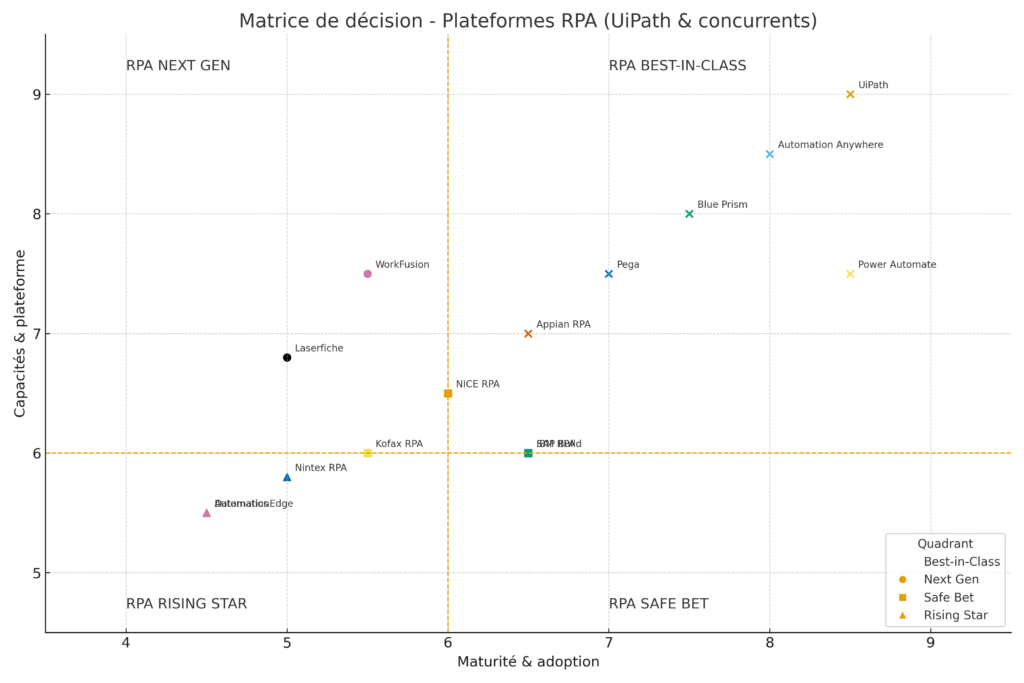
1. Axis variables

X axis - Maturity & adoption (0 → 10)
Installed base size
Global presence & partner ecosystem
Financial strength/perceived sustainability
Y axis - Capabilities & platform (0 → 10)
RPA richness (attended / unattended, orchestrator, governance)
Level of "intelligent automation" (AI, process mining, low-code, API, connectors)
Scalability & IS integration
The four quadrants can be named :
Top right : RPA BEST-IN-CLASS (mature + very functionally rich)
Top left : RPA NEXT GEN (high capacity, but adoption still limited)
Bottom right : RPA SAFE BET (well established, good capacity)
Bottom left : RPA RISING STAR / Niche (smaller players, partial coverage)
UiPath’s strength lies in its ” automation first ” approach, which covers the entire lifecycle of a robot:
Discover: thanks to Process Mining and Task Mining, UiPath identifies processes or tasks that are candidates for automation. The tools collect information system events or user actions to map flows and calculate their automation potential.
Design: the UiPath Studio workshop (and its simplified StudioX version for non-technical users) lets you model workflows using drag & drop, integrating ready-to-use activities or API calls. Workflows can include conditional branches, loops, AI service calls and human-in-the-loop interactions.
Execute: robots are available in :
Attended robots: triggered by the user, they provide real-time assistance with front-office tasks (data entry, information retrieval). Collaboration is via a thin-client agent.
Unattended robots: perform scheduled or event-driven tasks on servers or virtual machines. They handle back-office tasks 24 hours a day.
Test robots: used to automate application and workflow testing.
Manage: UiPath Orchestrator centralizes the management of robots, work queues, execution logs and queues. The Orchestrator enables job scheduling, task distribution and performance monitoring.
Measure: Insights provides pre-configured, customizable dashboards for tracking KPIs (processing time, error rate, ROI) and managing a portfolio of robots.
Engage: UiPath Apps and Integration Service enable you to build web applications or APIs orchestrating robots and integrating forms. UiPath Assistant offers a unified interface for launching and interacting with robots.
UiPath is investing heavily in AI and modernizing its ecosystem:
Agentic automation: UiPath’s vision is to use agents based on language models and conversational tools to make decisions and orchestrate actions. The official article states that the platform integratesgenerative AI, self-healing robots that adapt to interface changes, and extended OS coverage. The aim is to enable agents to converse in natural language with the business, understand instructions and generate automations.
Intelligent Document Processing (IDP): thanks to a combination of OCR, machine learning and rules, UiPath Document Understanding automatically extracts information from invoices, contracts or e-mails and integrates it into management systems.
AI Center and ready-to-use models: the platform offers a catalog of ML models (classification, entity extraction, content moderation) that can be deployed and consumed by robots. Customers can also import their own models or exploit third-party services (Azure OpenAI, Google Vertex AI…).
Autopilot: this new feature introduces an AI assistant that helps developers create workflows in natural language, generates regex expressions, suggests optimizations and suggests relevant activities. The aim is to democratize the creation of complex automations.
Test Suite: in response to the growing complexity of IS, UiPath offers automated test modules (app testing, API testing, RPA testing). The suite also includes agentic testing functionalities for evaluating AI agents.
Marketplace and connectors: the UiPath Marketplace offers thousands of packages (activities, connectors, snippets) developed by the community or partners. This richness makes it easy to create workflows without having to develop custom code.
Functional breadth: the platform covers the entire lifecycle, from discovery to orchestration, testing and portfolio management.
Extensive ecosystem: UiPath has a global community and local partners for integration, training and maintenance. The orchestrator is renowned for its ability to manage thousands of robots.
Accessibility: with StudioX and low-code/no-code models, UiPath targets business sectors and democratizes robot creation. This makes it possible to scale up projects, provided that appropriate governance is in place.
Agentic vision: UiPath anticipates changing needs by integrating AI agents and self-healing robots. This orientation prepares customers for the transition to intelligent automation.
Potential complexity: the richness of the platform implies an investment in training and the establishment of a solid architecture and governance. Without standardization, the multiplication of robots can lead to high maintenance costs.
Licensing model: although flexible (robots, users, cloud consumption), invoicing can become difficult to control in the event of a surge in demand. We recommend anticipating needs and negotiating suitable packages.
Product evolution: UiPath’s strategy evolves rapidly. Customers need to keep up with updates to benefit from new features (agentic automation, autopilot) and adapt their practices.
UiPath is the right choice when :
The company is aiming for large-scale automation and wants to industrialize RPA with a robust orchestrator.
The processes are varied: front-office and back-office, interactions with legacy systems (mainframe) and modern systems (API). UiPath manages different types of robots and a large library of connectors.
The aim is to combine RPA and AI: the platform natively integrates IDP, AI models and assisted code generation (Autopilot). This makes it possible to deploy intelligent automations.
Governance is an issue: UiPath offers tools for access control, version management and centralized supervision.
As the undisputed market leader, UiPath continues to reinvent itself. Its focus on agentic automation and the integration of generative AI show that simply automating tasks is no longer enough; it is now a matter of creating agents capable of making decisions and collaborating with humans. Companies wishing to embark on intelligent automation will need to equip themselves with the appropriate skills, put in place robust governance and choose partners capable of supporting them over the long term. UiPath, with its ecosystem and vision, is well placed to meet these challenges.