Artificial intelligence
From purchasing to carbon reduction – Building and civil engineering
Publiée le October 19, 2025
Publiée le October 19, 2025
Faced with the urgency of climate change and regulatory pressure, the construction industry is being forced to review its purchasing processes and production methods. The major companies that dominate this market are now using artificial intelligence (AI) and data science to reduce the carbon footprint of their projects, optimize the use of raw materials and strengthen the resilience of supply chains. While some French groups are content with exploratory approaches, competitors such as Bouygues Construction, Strabag SE and Vinci Construction have already industrialized solutions that are transforming their business models.
Artificial intelligence maturity of construction companies :
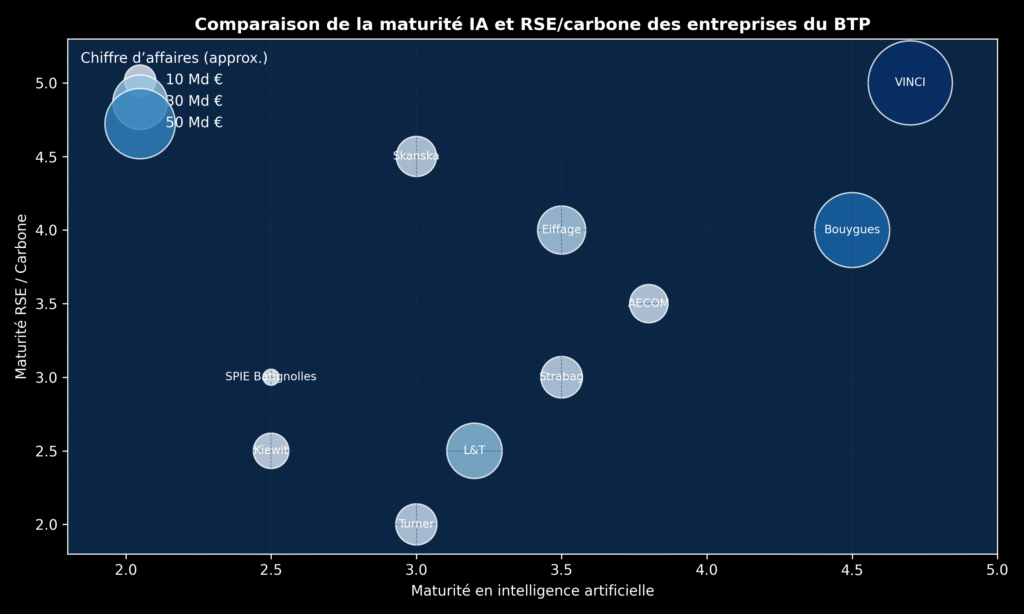
*Based on cross-referenced data, this matrix may contain approximations.
The first application of AI is well upstream, at the design stage. Bouygues Construction has a DataLab that supports its design and execution teams. On line 15 of the Paris metro, engineers used generative design algorithms to redesign the retaining wall at Saint-Cloud station. This change saved 140 tonnes of steel and reduced the project’s carbon footprint, while maintaining the same structural strength. Such optimization of material quantities translates directly into lower purchasing and CO₂ emissions, and shows that AI is capable of proposing solutions that human teams, subject to tight deadlines, would not always test.
Real-time data collection and analysis play a key role in adjusting site logistics. Bouygues Travaux Publics’ Lab TP team, initially dedicated to TBM projects, now supports a wide variety of worksites. On the Fécamp offshore wind farm, the engineers analyzed positioning and utilization data for four cranes. They found that crane saturation was not due to a lack of equipment, but to unnecessary movements and interference. By reorganizing routes and repositioning cranes, productivity was increased tenfold, while avoiding the need to purchase new equipment. This data-driven approach to logistics shows how an innovation department can tackle problems perceived as unsolvable by the field.
Purchasing is not limited to materials; it also encompasses project selection. Strabag SE, a major European manufacturer, has set up a data science hub in collaboration with Microsoft. One of the hub’s first applications is a project pre-qualification algorithm. By comparing a project with thousands already completed, the tool estimates financial and technical risks, including weather effects (possibility of immobilizing a crane) and cost relevance. With just three months’ data, the algorithm achieves 80% accuracy in risk prediction.microsoft.com. Teams can therefore decide to abandon a risky call for tenders even before spending time or money on it, thus avoiding considerable losses.
Optimizing purchasing also involves replacing traditional materials with greener solutions. Vinci Construction reports that more than 60% of the concrete used on its sites in France in 2024 was low-carbon concrete (Exegy® brand), and that the company is aiming for 90% by 2030. vinci-construction.com. These materials reduce carbon footprints without requiring major changes to the supply chain. Purchasing units need to review their criteria, however, as AI can help them assess the overall cost of a solution: purchase price, transport, carbon footprint, social impact…
Additive manufacturing is also changing the way materials are purchased. In France, CyBe and Bouygues Immobilier Grand Ouest built a small building in 2020 called “La Sphère”, whose walls were printed on site using a robotic arm. The process used 30% less concrete than a traditional structure. This experiment foreshadows the arrival of off-site factory production, driven by start-ups like XtreeE that print optimized concrete elements, reducing the amount of material purchased and transported.
To integrate these solutions, governance must evolve. The purchasing and CSR managers of major groups are no longer content to negotiate prices, they are orchestrating the digital and environmental transition. At Bouygues Construction, this approach is reflected in a multi-disciplinary DataLab that collaborates with worksite and R&D teams to select relevant use cases. The lab prioritizes projects that can be rapidly deployed in the field and offer high added value.
Buyers also need to work with legal experts and data scientists to secure contracts. Vinci Construction, for example, is developing an AI tool that pre-selects irregular clauses in contracts and spots risky passages during the execution phase. This automation of contract reviews reduces costs, limits disputes and improves the quality of partnerships with suppliers.
To implement these innovations, the major construction companies are relying on an ecosystem of start-ups. In addition to XtreeE, specialized in 3D printing, and CyBe, other players are emerging:
Deepki: this start-up provides a sustainable performance monitoring platform for real estate assets. It offers AI-assisted “virtual retrofits” to simulate the impact of an investment on carbon footprint and operating costs. This enables real estate managers to prioritize actions and justify their purchases to financiers.
ALICE Technologies: adopted by Bouygues Construction and other groups, its planning solution simulates millions of construction scenarios to optimize resources and reduce lead times. The results influence the ordering of materials and the mobilization of subcontractors.
Mastt: a software package used notably in Australia that automates reporting, predicts risks and generates financial dashboards. It enables owners to monitor budgets and detect deviations in real time.
Start-ups analyzing legal documents: the LegalAize application, developed with Amazon Web Services, uses generative models to analyze contracts and flag risky clauses. This service enhances contractual protection and facilitates complex purchases.
Integrating AI into the purchasing chain is just the first step. Industry leaders are increasingly adopting a circular model in which materials are reused and waste recovered. AI can help identify reuse deposits, plan selective deconstruction and optimize recycling logistics. Material traceability solutions, based on blockchain or RFID sensors, complement forecasting algorithms to anticipate future needs and avoid overproduction.
Last but not least, the rise of green taxonomy and the obligation to publish emissions reports reinforce the importance of reliable carbon indicators. Analytical platforms and predictive models enable purchasing managers to anticipate changes in the cost of raw materials and carbon quotas. They can thus arbitrate between different options (recycled material, local product, innovative manufacturing method) while taking into account the carbon criterion.
AI is profoundly transforming the purchasing and carbon strategy of construction majors. While some companies are struggling to move beyond experimentation, players such as Bouygues Construction, Strabag and Vinci are demonstrating that it is possible to industrialize materials optimization solutions, anticipate project risks and digitalize contract management. These advances give purchasing departments a central role in the environmental and digital transition. They show that a strategy based on data, collaboration with start-ups and the in-house development of AI skills is an effective response to the sector’s environmental and economic challenges.