Finance & Performance
List of EPM tools
Publiée le November 28, 2025
Publiée le November 28, 2025
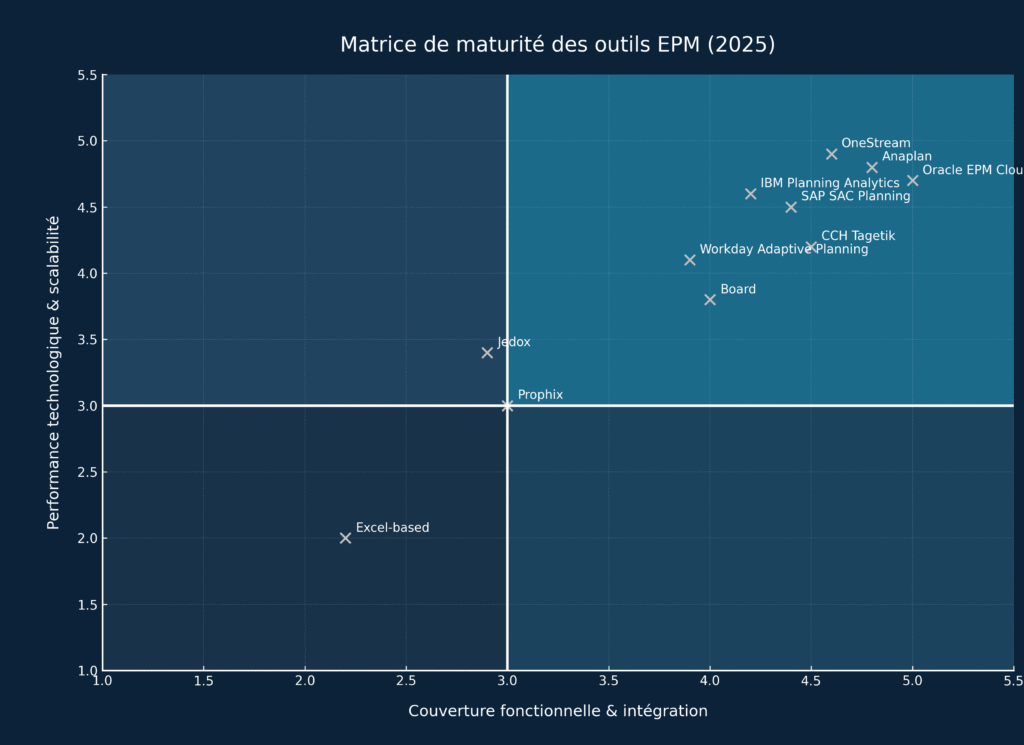
Enterprise Performance Management (EPM) occupies a strategic position within modern organizations. Faced with fast-changing markets, growing volumes of data and the need for even greater precision in corporate management, EPM tools have become indispensable platforms for orchestrating planning, financial consolidation, reporting, analysis and decision-making. The market today abounds with a variety of technological solutions, ranging from powerful integrated suites to specialized tools capable of meeting the most complex requirements. To help organizations navigate this diversity, we offer an in-depth list of the main EPM tools available on the market, together with a detailed analysis of their strengths, specific features and the contexts in which they excel.
Oracle EPM Cloud is one of the most comprehensive solutions on the market, designed to meet the needs of both large international companies and growing organizations looking for a robust, scalable platform. Its suite covers the entire management chain: planning, budgeting, forecasting, financial consolidation, reporting, tax management, profitability management and scenario analysis.
One of its major assets is its ability to process massive volumes of data while guaranteeing high performance. Its cloud architecture ensures continuous scalability, regular updates and advanced environment security. Finance departments particularly appreciate the richness of its pre-configured templates, which accelerate deployment, as well as its ability to centralize global financial processes within a unified architecture.
SAP Analytics Cloud, and more specifically its Planning module, is a next-generation EPM tool that combines planning, business intelligence and predictive intelligence within a single platform. This technological convergence represents a considerable advantage: teams can plan, analyze, visualize and model performance in a single environment, streamlining collaboration and reducing tool fragmentation.
Thanks to its deep integration capabilities with SAP ERPs, SAC Planning is particularly relevant for companies already working in the SAP ecosystem. Its cloud orientation, simulation functionalities and use of predictive algorithms enable organizations to anticipate trends with greater precision and manage continuous planning cycles.
Anaplan has established itself as one of the leaders in Connected Planning. Its strength lies in its hyperscalable cloud platform and high-performance calculation engine (Hyperblock), capable of simultaneously managing huge volumes of data, models and users.
Anaplan stands out for its extreme flexibility, enabling you to model highly complex processes, integrate data from multiple sources, and connect finance, HR, supply chain, sales, marketing and operations within a single planning environment.
Its collaborative approach, intuitive interface and ability to model cross-functional workflows make Anaplan the preferred choice for organizations seeking to decompartmentalize their processes and establish a culture of continuous, shared planning.
OneStream is a high-end, unified EPM solution, particularly renowned for its power in financial consolidation and regulatory reporting. Unlike other tools, which are based on several modules, OneStream offers a single platform, extensible by means of pre-packaged solutions called MarketPlace, enabling the integration of planning, modeling, forecasting, financial risk management, reporting and analysis.
Its value lies in this unified architecture, which eliminates the complexity of integration between modules and offers total data consistency. OneStream is often favored by international groups with complex structures, multiple subsidiaries or stringent compliance requirements. The solution also stands out for its ability to automate closing processes and reduce consolidation times.
IBM Planning Analytics, based on the TM1 engine, is an EPM solution particularly appreciated for its calculation speed, robustness and advanced flexibility. TM1 makes it possible to model extremely complex financial and operational scenarios, while offering granular control of data structures.
Thanks to its multidimensional cubes, advanced integration with Excel (via Planning Analytics for Excel) and Watson-enhanced analytical capabilities, IBM Planning Analytics is a solid choice for companies looking to combine computing power, advanced analysis and modeling flexibility.
This solution is particularly well suited to organizations with sophisticated models requiring intensive real-time calculations.
Board is an all-in-one platform combining business intelligence, planning and analytics. It is unique in its ability to offer a fully integrated experience where reporting, analysis and planning are based on a single data model.
Its functionalities cover financial planning, forecasting, modeling, interactive dashboards and performance analysis. Board is particularly suited to companies looking for an intuitive, visual, collaboration-oriented solution incorporating advanced functionalities without requiring a high level of technical expertise.
The flexibility of its model and its data storytelling capabilities make it an ideal tool for managers who want structured, yet accessible, management.
Workday Adaptive Planning (formerly Adaptive Insights) is a cloud-based planning solution designed to provide a seamless experience for FP&A, HR and operational teams. Its intuitive interface, rapid deployment and ability to model collaborative plans make it a popular tool for medium-sized and large companies.
Workday Adaptive Planning stands out in particular for its ease of use, its collaborative orientation and its ability to connect finance and human resources in integrated plans, which is an important advantage in organizations where the workforce represents a major strategic lever.
The solution is particularly well suited to companies looking for a modern, flexible alternative to traditional tools, with a low learning curve and highly appreciated ergonomics.
CCH Tagetik is a complete EPM solution covering financial consolidation, planning, regulatory reporting and performance management. It stands out for its strength in environments subject to stringent regulatory requirements, such as the banking, insurance, healthcare or energy sectors.
Tagetik excels in the management of complex rules, statutory reporting, IFRS processes, Solvency II, IFRS 17 and narrative reporting. Its advanced planning capabilities and consolidation power make it a reliable solution for large groups with tight regulatory constraints.
Prophix is an EPM solution aimed at mid-sized companies seeking to improve their planning, budgeting and reporting without committing to major transformation projects. Its ease of deployment, value for money, collaborative features and automated planning capabilities make it an attractive alternative for less complex environments.
Prophix is also an ideal intermediate step for companies wishing to replace Excel with a structured tool before eventually migrating to a more powerful EPM solution.
Jedox is an EPM platform based on a powerful multidimensional calculation engine, designed to offer great modeling flexibility while maintaining a strong link with Excel. It is particularly appreciated in environments where teams wish to retain a high degree of autonomy in model creation, without being constantly dependent on IT.
Thanks to its planning, analysis and reporting functions, Jedox is ideal for organizations looking for an adaptable tool that can gradually evolve towards more complex models.
The selection of an EPM tool depends on several factors:
the complexity of the financial structure ;
consolidation requirements ;
internal analytical culture ;
level of technological maturity ;
planning requirements (finance, HR, supply chain, sales, etc.) ;
regulatory constraints ;
resources available for deployment.
No EPM tool is universal. Some excel in planning (Anaplan, Workday), others in consolidation (OneStream, Tagetik), still others in BI-Planning unification (Board, SAP Analytics Cloud).
But they all share a common objective: to offer companies agile, structured and data-driven management.
In a world where anticipation is becoming a major competitive advantage, EPM is now one of the strategic pillars of corporate performance.