Customer & Marketing
Omnichannel banking: how to optimize your presence across all channels?
Maxime MARY
Publiée le October 24, 2021
Maxime MARY
Publiée le October 24, 2021
The digitization revolution, driven by technological and societal changes, has profoundly altered distribution patterns in the financial industry, driven by the continuous growth of channels and uses, leading to an increase in interactions and the complexity of managing them in an omnichannel approach.
Companies have developed their ability to respond by channel as customers have adopted them (telephone, email, website, mobile applications, social networks, etc.).
However, beyond the transformation of retail banking, traditional market players have had to adapt in response to the new standards imposed by online banks, but also in the face of GAFA and Fintechs. Digitization has created new standards, such as unlimited availability, hyper-evolutionality, increased personalization and the creation of ecosystems with third-party solutions. Today’s consumers are accustomed to these standards, and want to see them applied across all channels in their relationship with their bank.
The adoption and massive mastery of new communication channels has made the population more agile in its navigation between channels. Concentrations of age groups on certain channels are disappearing in favor of joint use of channels. Implementing an omnichannel strategy for retail banking has therefore become a priority for the majority of players (a priority strategy for 88% of US banks in 2019 according to a March 2019 Celent study ).
Today’s siloed multi-channel strategy has proved incompatible with the customer journey, which today can start on one channel and continue on a second. The possibility of accessing banking services through a variety of channels (multi-channel strategy) has come up against the siloing of channels, preventing the continuity of operations between them. The challenge of an omnichannel organization is to ensure interconnection between channels in real time, so that it is always possible to switch from one channel to another, without any loss of data.
Aware of these challenges, banks have begun their transition to an omnichannel organization. However, beyond the technical and organizational challenge of ensuring fluidity between channels, the real challenge in setting up an omnichannel organization is to master the solutions offered by this organization, in order to integrate them into the resolution and proximity strategies deployed by traditional banks.
Indeed, despite the technical efforts made by banks as part of their omnichannel strategy, the explosion in customer flows through different channels has profoundly shaken up previously established customer management processes such as portfolio or individualized management.
Yet the local network retains a strategic role, remaining a key pivot in customer relations and the most transformative channel in terms of business. However, agencies face the paradox of being both the channel with the highest conversion rate, and also the channel that is often least well integrated into the omnichannel organization.
The challenge is to ensure continuity of service and experience across all relationship entry channels.
To meet these challenges, the strength of the collective must be a powerful lever of relational excellence and responsiveness in a distribution model that preserves the quality of demand processing (IRC), by guaranteeing the right expertise and the right sharing of knowledge and customer relationship history.
Several models for integrating network skills into an omnichannel model are possible, and need to be aligned with the commercial distribution strategy, while taking technological constraints into account, in order to ensure efficiency over time with appropriate management.
At Palmer Consulting, we are convinced that the success of an omnichannel organization depends on its ability to identify customer intentions and the key skills to be deployed in response to these requests. Without implementing the “intention/skills” matrix, the bank’s failure to adapt will inevitably result in poor omnichannel reachability and an insufficient resolution rate.
Banks’ ability to meet these challenges will depend heavily on their ability to rethink their organization and tools, to put the customer journey at the heart of their commercial distribution strategy.
In the banking sector, customers have high expectations in terms of contactability. There are two main ways of meeting these expectations: on the one hand, responsiveness to customer requests, which implies a certain degree of availability on the part of the advisor, but also an ability to respond to the request; and on the other, quality of service.
In terms of responsiveness, the advisor, who is considered a pillar of customer relations, cannot be available at all times and on all channels to respond to all the requests of the customers in his or her portfolio. To remedy this, it is necessary to deploy a certain solidarity and the strength of the collective, whether in terms of proximity in the branches or expertise in the various call centers and other middle offices.
In terms of service quality, a customer-centric service culture is essential. For this, centralized strategic supervision and local operational supervision can provide an appropriate response. The distribution of omnichannel flows according to employee skills must not only be adapted to the customer’s profile, but also to his or her needs, to guarantee the quality of request processing.
These two levers – responsiveness and service quality – place the customer journey at the heart of the omnichannel strategy, and guarantee customer satisfaction.
Omnichannelity requires a system, organization and management approach that reconciles flow management activities, which are currently constrained by the compartmentalization of community tools into silos. The aim is to harmonize the display of and access to different channels, and the organization of skills and expertise, in order to optimize the orchestration and management of customer relations flows.
To achieve this, several factors influence the definition of the flow management model: the level of customer autonomy, the maturity and level of integration of available solutions, the skills and expertise development model, the customer relationship management culture, and finally, the type and volume of customer requests.
All these factors can be optimized to ensure the success of a customer relations program. Optimizing omnichannel flows requires consensus on the issues and priorities at stake, as well as the identification of limits and constraints. To achieve this, the project needs to be anchored in a co-construction approach, to ensure that the diagnosis is properly appropriated by the teams.
In the banking sector, management can be used to reconcile all customer and advisor activities, across all channels. In fact, there are 2 major optimization stages:
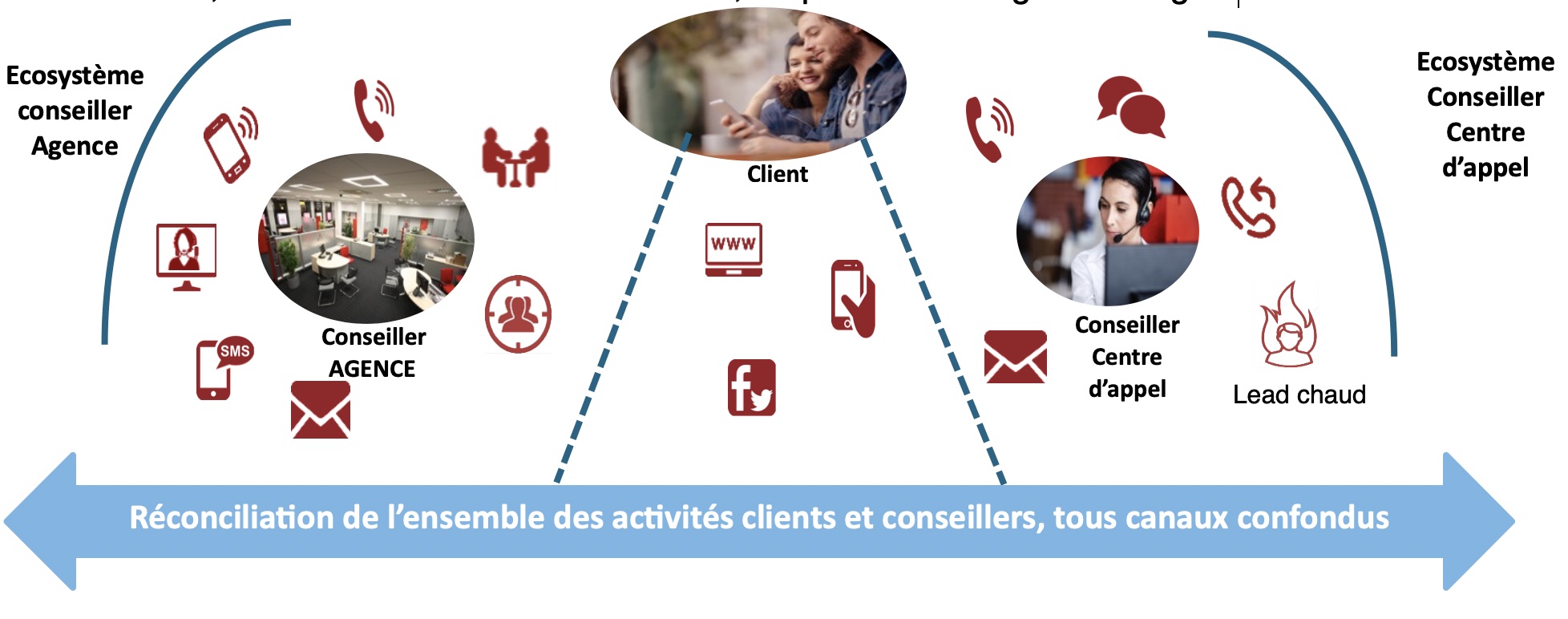
Establishing an effective flow management strategy involves a number of tasks. First of all, we need to map out the commercial distribution system, and then do the same with the various omnichannel flows.
Omnichannel flows can be mapped and analyzed using two approaches: a quantitative/qualitative approach, and an approach based on universes of need. For quantitative analysis, we can analyze the flow paths per channel: flow qualification system, flow targeting and distribution rules, organization of players, schedule management, etc. We can also measure the flow of customer contacts by channel and measure the processing of these requests (response rate, complaints and satisfaction rate, estimated time per processing). For qualitative analysis, interviews can be conducted with operational staff, to gather their needs and experiences. For a needs-based approach, we can qualify these contact flows by market, in order to analyze areas of underperformance or even malfunction.
Once the omnichannel flows have been inventoried, we need to prioritize the analysis of high-stake channels to rapidly add value to local networks.
Finally, the last strategic component will be based on a diagnosis of the distribution model for flows and priorities.
Against a backdrop of massive growth in digital customer usage, where the Covid-19 crisis has further accentuated the use of remote channels (-26% bank branch appointments, +16% email, +17% telephone), it’s reasonable to say that omnichannel usage is booming.
However, in the banking sector, The Financial Brand explains that “as almost 60% of traditional banking products are still sold in branches, it’s hard to argue that the physical network still doesn’t play an important role”. Indeed, according to PwC, “branches will remain, but they will take many forms, from simple information points, to advice and underwriting centers, to intelligent self-service banking kiosks”.
Even though the proliferation of digital channels has made omnichannel the norm, the local network retains a strategic role, remaining a pivotal point in customer relations. This role will be accompanied by a move upmarket in services, including paid advisor services, justifying massive investment in an omnichannel model orchestrating reachability, responsiveness and expertise.
Maxime MARY