Strategy & Transformation
Scope 4: anticipating positive impacts in carbon audits
Thibault Demoulin
Publiée le January 15, 2025
Thibault Demoulin
Publiée le January 15, 2025
At a time when the urgency of climate change is forcing companies to make rapid transformations, the notion of Scope 4 is becoming a strategic lever. This innovative concept complements the traditional approaches of direct emissions (Scope 1), indirect emissions (Scope 2) and emissions linked to the value chain (Scope 3) by integrating avoided emissions. In other words, it measures the positive impact that an organization’s innovations can have on the global carbon balance. This approach redefines not only the carbon footprint of companies, but also their ability to align their business model with ambitious environmental objectives. Find out more about Scope 4 and the positive impacts of carbon footprints in this article.
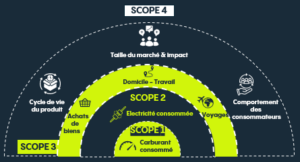
Scope 4 represents a paradigm shift. Unlike the first three scopes, which only count the emissions produced, it focuses on the positive environmental impacts linked to the solutions proposed by a company. For example, an organization developing renewable energy technologies can include in its carbon footprint the emissions avoided through the use of its products by others.
Although less widespread, this methodology is gaining recognition thanks to frameworks such as ISO standards and the requirements of the CSRD (Corporate Sustainability Reporting Directive). These developments are encouraging companies to go beyond simply managing their carbon footprint, and embark on a process of global transformation.
Measuring avoided emissions offers a new perspective on companies’ carbon footprints. Measuring avoided emissions offers a new perspective on companies’ carbon footprint. It makes it possible to quantify the positive contribution of innovations and demonstrate how they respond to climate challenges. This approach not only benefits the environment; it also brings strategic advantages.
By integrating avoided emissions into their strategy, companies can build a resilient and differentiated business model. They improve their transparency vis-à-vis stakeholders, notably by aligning their communication with regulatory frameworks such as the CSRD. In addition, this approach fosters the adoption of relevant action plans, aligned with long-term objectives and compliant with ISO standards, while maximizing their credibility in the marketplace.
Adopting Scope 4 in a company’s carbon footprint offers multiple advantages. Firstly, it enhances the value of innovation efforts by highlighting concrete environmental impacts. Secondly, it makes it easier to meet the growing expectations of stakeholders, who are looking for companies capable of playing a leading role in the ecological transition.
In addition, Scope 4 facilitates the implementation of strategic action plans and contributes to compliance with increasingly demanding regulatory frameworks. This approach can transform the carbon footprint of a constraint into a competitive advantage, while strengthening the organization’s resilience in the face of economic and climatic challenges.
In the race towards carbon neutrality, Scope 4 offers an optimistic perspective. By recognizing the positive environmental impacts of solutions brought to market, it balances reduction and innovation efforts. This approach complements other initiatives, while integrating harmoniously with the objectives of ISO standards and CSRD reporting requirements.
By including Scope 4 in their carbon footprint, companies are doing more than simply offsetting their emissions: they are actively participating in a systemic transformation, guided by concrete, measurable solutions.
Conclusion and recommendations
Scope 4 and its positive impact on carbon footprints are redefining the way companies think about their carbon footprint and their role in addressing climate change. It’s no longer just a question of reducing a carbon footprint, but of adopting a proactive vision in which innovations contribute directly to positive environmental impacts on a global scale.
At PALMER, we support our customers in implementing ESG strategies. Thanks to our expertise and the requirements of the CSRD, we help companies transform their carbon footprints into levers for competitiveness and sustainability.
Would you like to rethink your ESG strategy? Would you like to learn more about Scope 4 and positive impacts in carbon footprints? Contact our experts today.