Artificial intelligence
Site safety – Construction
Publiée le October 19, 2025
Publiée le October 19, 2025
The building and civil engineering sector is one of the most exposed to workplace accidents: falls from height, collisions between machinery and workers, collapses, heat-related ailments. While many companies are struggling to reduce the number of incidents sustainably, some international leaders have invested in artificial intelligence (AI) and Internet of Things (IoT) solutions that are transforming prevention. TheseAI in construction can detect risks in real time, help teams prioritize actions and improve compliance. This approach is in line with the concerns of health and safety managers: how can risks be detected in real time? How can we provide teams with actionable information? How to comply with RGPD while exploiting images?
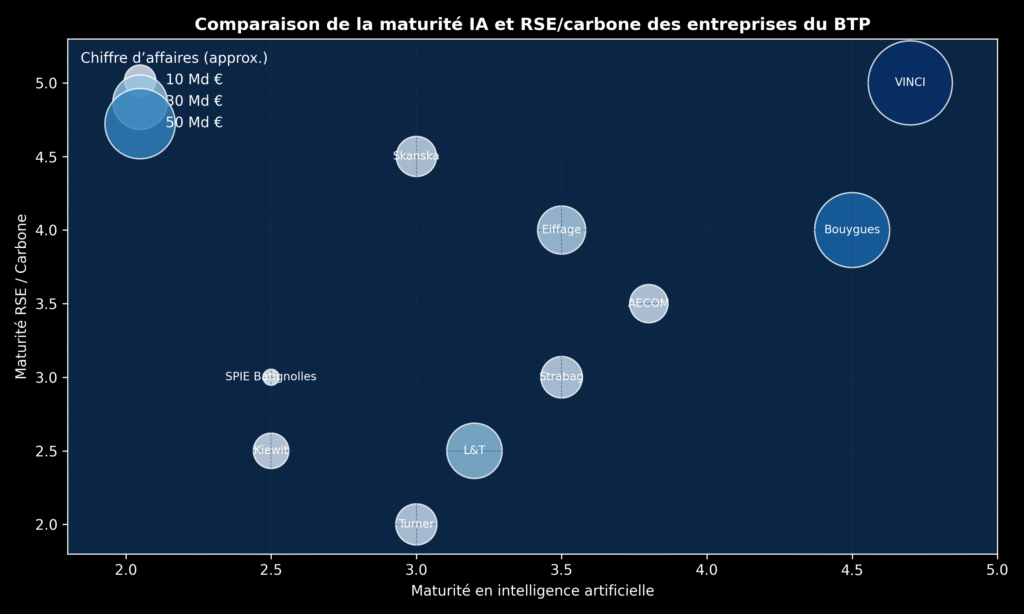
Maturity matrix for construction companies :
*Palmer Research based on cross-referenced data
Construction accidents are often the result of delays or poor planning. STRABAG SE uses a risk forecasting system based on Azure OpenAI. The tool compares each new project with thousands of completed projects, and incorporates external data (wind speed, rainfall, logistics) to predict delays, cost overruns and the most likely hazards. With just a few months’ data, the system achieves 80% accuracy, alerting teams when weather conditions are likely to immobilize a crane or increase the probability of a fall. This anticipation enables us to adapt schedules, modify methods and prevent accidents.
On an offshore wind farm, Bouygues Travaux Publics’ Lab TP analyzed the positions and movements of several cranes and demonstrated that interference between machines was the cause of a great deal of lost time and risky situations. Optimizing crane positioning and trajectories increased productivity tenfold. The same approach can be used to identify areas of conflict between pedestrians and machines, or to plan buffer zones to limit interactions.
Visual surveillance becomes a key element of prevention. Vinci Construction uses the OpenSpace platform, which combines 360° cameras with image processing. Operators equipped with helmets or smartphones perform a check walk, and AI automatically identifies areas where work is complete, overdue or non-compliant. On 25 projects in the UK, this solution has saved over 5,200 man-hours by avoiding unnecessary visits and enabling progress to be checked remotely.
Buildots, a start-up, equips workers’ helmets with cameras linked to an algorithm that compares the state of the site in real time with the schedule and the BIM model. The system pinpoints missing or incorrectly installed elements and generates a precise dashboard for each company involved. On a site managed by Nordic contractor NCC, the use of Buildots increased task completion rates by 230% and reduced reporting time by 70%. These solutions contribute to quality and safety by identifying errors before they become hazards.
China State Construction has set up intelligent worksites based on 5G, where cameras and sensors constantly monitor work areas. AI analyzes images to check that PPE (helmets, harnesses) is worn, detect intrusions into prohibited areas and spot obstacles. Real-time alerts enable site managers to react immediately and avoid serious accidents.
Indian construction giant Larsen & Toubro (L&T) has developed a digital ecosystem for over 200 projects. On-board cameras detect missing gloves, unfastened helmets and missing harnesses. Combined with tracking drones, these devices provide an overview and flag up dangerous behavior.
In the United States, Turner Construction has adopted the CraneView sensor, developed by start-up Versatile. Attached to crane hooks, this device records each lift, identifies the load and measures the duration of each cycle. On the Manchester Pacific Gateway site in San Diego, AI revealed idle times and inefficient lifts. Using this information, Turner adjusted the team allocation and was able to demobilize a crane earlier than planned, saving time and money. The system also provides safety indicators, for example when the load is out of balance, helping to reduce hoist-related incidents.
Larsen & Toubro uses IoT sensors coupled with AI to monitor material and fuel usage on over 300 construction sites. One of the ecosystem’s modules calculates the optimum cut for rebar to reduce metal waste, while another measures diesel consumption and flags any abnormal use (leakage, theft, misuse). These tools help prevention teams to anticipate shortages and reduce emergency situations (lack of supplies, site stoppages).
Some worksites are testing devices worn by workers, such as exoskeletons and posture sensors. Coupled with learning algorithms, they detect at-risk postures and suggest adjustments. Although these solutions are still in the pilot phase, they hold out the promise of progress in reducing MSDs, the leading cause of occupational illness in the construction industry.
The use of cameras and sensors raises ethical issues. China State Construction and other companies impose a strict framework: images are anonymized, only authorized persons have access to data, and social and economic committees must validate the devices. Similarly, Strabag points out that automated decision-making must remain under human supervision, and that the priority is to assist workers, not monitor them. microsoft.com. To ensure team buy-in, it is essential to involve employee representatives right from the project design stage, and to communicate clearly on the objectives and purpose of the data.
In addition to the solutions already mentioned, several start-ups are bringing complementary innovations:
CAD.42: this French company develops connected sensors for monitoring cranes and work areas. Combined with a vision algorithm, these sensors detect the risk of collision between machines and pedestrians, and identify dangerous lifts. Feedback from worksites indicates a significant reduction in near-misses.
Chronsite: part of Leonard’s (Vinci) innovation program, this solution uses cameras and learning algorithms to measure the duration of tasks on site and detect delays. It provides indicators for adjusting the schedule and avoiding overstretching teams.
Exodigo: a Vinci partner, this Californian start-up processes radar, electromagnetic and LiDAR data to map buried networks. This mapping reduces the risk of damaging cables or pipes during excavations, and contributes to safety.
The experiences of these leading companies show that AI and IoT deliver value when integrated into an overall strategy. Safety doesn’t have to be managed in silos: it interacts with planning, logistics and cost management. Thanks to data collection and algorithms, companies can move from a culture of reaction to one of prevention.
However, these technologies require investment in infrastructure (connectivity, storage, computing power) and data analysis skills. Prevention teams need to be trained to interpret dashboards and take rapid corrective action. Last but not least, collaboration between OEMs, equipment suppliers and start-ups is essential to adapt solutions to the specific constraints of the field.
Construction site safety is a major challenge for the entire construction industry. The innovations described show that AI and connected objects do not replace humans, but assist them by providing useful information and automating the detection of dangerous situations. Industry leaders – Strabag, Bouygues, Vinci, China State Construction, Larsen & Toubro, Turner – are demonstrating that by combining forecasting, computer vision and sensors, it is possible to significantly reduce accidents. Companies that fail to embark on this transformation risk being left behind, both socially and economically.