Artificial intelligence
The rise ofgenerative artificial intelligence is profoundly transforming our society. Behind this revolution are LLMs (Large Language Models), capable of understanding and generating text, programming and even multimodal content.
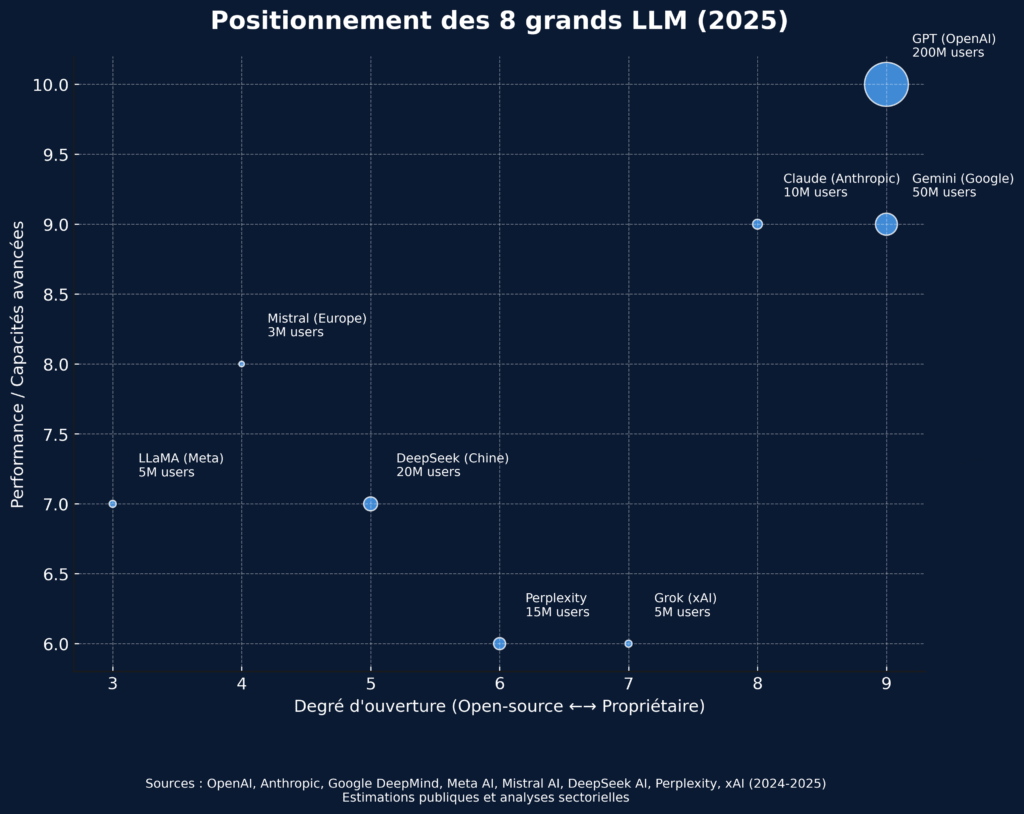
By 2025, eight models will dominate the global landscape: GPT (OpenAI), Claude (Anthropic), Gemini (Google DeepMind), LLaMA (Meta), Mistral (Mistral AI)DeepSeek (China), Perplexity and Grok (xAI). Each brings a unique vision of the future of AI.
Questions about AI? Contact us now!
1. GPT (OpenAI): the pioneer and world leader
Presentation
Developed by OpenAI, GPT is the model that popularized generative AI. From GPT-3 (2020) to GPT-5 in 2025, it remains the benchmark for LLM.
Forces
-
Fluid, natural text.
-
Versatility (writing, coding, analysis).
-
Robust ecosystem (ChatGPT, Microsoft Copilot).
Applications
-
Conversational chatbots.
-
Document automation.
-
Code generation via GitHub Copilot.
2. Claude (Anthropic): safety and the long view
Presentation
Launched by Anthropic, Claude stands out for its focus on safety andethical alignment.
Forces
-
Analysis of very long contexts (up to 200k tokens).
-
Reliable reasoning.
-
Less risk of biased answers.
Applications
-
Customer support.
-
Legal and financial analysis.
-
Extensive documentary research.
3. Gemini (Google DeepMind): native multimodality
Overview
Gemini is Google DeepMind’s flagship model, the successor to PaLM 2.
Forces
-
Integrated multimodality (text, image, audio, code).
-
Google ecosystem (Docs, Gmail, Search).
-
High search power.
Applications
-
Productivity assistants.
-
Multimodal research.
-
Educational tools.
4. LLaMA (Meta): open-source on a grand scale
Presentation
Meta launched LLaMA to democratize LLMs viaopen-source.
Forces
-
Free and accessible.
-
Works on limited hardware.
-
Support from an active community.
Applications
-
Fine-tuning for specialized sectors.
-
Academic research.
-
On-board deployment.
5. Mistral (Mistral AI): the European alternative
Presentation
Founded in 2023 by former researchers from DeepMind, Meta and Hugging Face, Mistral AI is a French start-up that in just a few months has become one of the world leaders in generative artificial intelligence. What sets it apart is the development of open-weight models, with a focus on transparency, technical performance and European sovereignty.
Right from the start, Mistral AI made its mark with Mistral 7B, a compact yet powerful model, followed by Mixtral 8x7B, which introduced the Mixture of Experts (MoE) approach to the open-source landscape. In 2024, the company launched Mistral Large, capable of competing with the best proprietary models such as GPT-4 and Claude.
Mistral’s ambition goes beyond mere technological competition: the start-up wants to offer Europe a world-class player in AI, capable of competing with the American (OpenAI, Anthropic, Google) and Chinese (DeepSeek, Baidu) giants.
Forces
-
High performance despite reduced size
Contrary to the prevailing logic of increasingly massive models, Mistral takes a different approach: designing optimized, efficient models.-
Mistral 7B quickly demonstrated that a model with 7 billion parameters could rival much larger models in terms of generation quality and reasoning.
-
This optimization reduces energy consumption and facilitates deployment, even on less powerful infrastructures than those required for GPT-4.
-
-
Innovative architecture: Mixture of Experts (MoE)
With Mixtral 8x7B, Mistral has popularized the use of Mixture of Experts in open-source.-
Rather than activating all of the model’s parameters, only a specialized subset is mobilized for each query.
-
The result: greater efficiency (fewer unnecessary calculations) and greater adaptability (each “expert” specializes in certain types of task).
-
This approach enables Mixtral to achieve performance close to that of much heavier models, while being faster and less costly to operate.
-
-
Strong European sovereignty
Mistral is asserting itself as a credible European alternative to the American and Chinese giants.-
By offering open-weight models, it sets itself apart from OpenAI and Anthropic, who keep their models closed.
-
This strategy responds to a strategic challenge: guaranteeing Europe’s technological independence in the critical field of generative AI.
-
Backed by public and private investors, Mistral has become a symbol of European digital sovereignty, attracting strong interest from institutions and major corporations alike.
-
-
Rapid adoption and international recognition
-
Mistral’s models are already being used in industrial, academic and open-source projects.
-
They appear in numerous benchmarks and publications as essential references.
-
Mistral benefits from high media visibility, embodying the idea that a European start-up can compete with American leaders.
-
Applications
-
High-performance multilingual assistants
Mistral’s models are naturally multilingual, with a particular focus on European languages. This makes them useful IA assistants not only for English, but also for French, German, Spanish, Italian, etc. -
Sovereign AI solutions for companies and governments
In a context where the issue of data protection is crucial, Mistral offers an alternative to American or Chinese solutions.-
European companies can deploy their own Mistral models, without having to rely on a foreign supplier.
-
Governments see it as a response to the challenges of digital sovereignty, particularly in sensitive sectors such as defense, healthcare and finance.
-
-
Open-source research and innovation
True to its philosophy, Mistral regularly publishes its models on an open-weight basis.-
This encourages academic research and experimentation.
-
The community is developing an ecosystem of tools, fine-tuning and derivative applications around Mistral.
-
This openness positions Mistral as an engine for collaborative innovation, in contrast to the closed approaches of OpenAI or Anthropic.
-
-
Industrial adoption and edge AI
Thanks to its optimized models, Mistral can be deployed on less expensive infrastructures.-
This opens the way to embedded applications (IoT, edge computing).
-
This enables companies to integrate advanced NLP capabilities without having to invest heavily in high-end servers.
-
6. DeepSeek (China): the champion of efficiency
Presentation
DeepSeek made its mark in 2024-2025 with DeepSeek V3 and R1, proving that it’s possible to train a high-performance model on a shoestring budget.
Forces
-
Record energy efficiency.
-
Very low training costs.
-
Partially open-source.
Applications
-
Economic alternatives to US giants.
-
Mass adoption in Asia.
-
Education and public services.
7. Perplexity: real-time search AI
Presentation
Perplexity AI is not just a model, but a search assistant based on LLM, with an approach focused on navigation and source verification.
Forces
-
Direct web connection: up-to-date answers.
-
References cited systematically (unlike classic hallucinations).
-
Optimized interface for searching and learning.
Applications
-
University documentary research.
-
Journalism and business intelligence.
-
Productivity tool for knowledge professionals.
👉 Perplexity sets itself apart by combining LLM + search engine, offering a credible alternative to Google Search.
8. Grok (xAI – Elon Musk): the “rebel” AI
Presentation
Developed by xAI (Elon Musk’s start-up), Grok is integrated into the X platform (formerly Twitter).
Forces
-
Direct access to real-time X/Twitter data.
-
A more “rebellious” and humorous tone, designed to stand out from ChatGPT.
-
Fast, social conversational context.
Applications
-
Chatbot integrated into X.
-
Social interaction and live content generation.
-
Experimentation for the general public.
👉 Grok relies on a differentiated, casual approach, attracting users from the X network.
Comparative table of the 8 major LLMs (2025)
| Model | Organization | Key strengths | Flagship applications |
|---|---|---|---|
| GPT | OpenAI | Versatile, fluid | ChatGPT, co-pilots |
| Claude | Anthropic | Safety, long context | Analysis, support |
| Gemini | Google DeepMind | Multimodality | Search, productivity |
| LLaMA | Meta | Open-source | Research, edge AI |
| Mistral | Mistral AI | MoE, sovereignty | Assistants, Europe |
| DeepSeek | DeepSeek AI | Efficiency, low-cost | Adoption Asia |
| Perplexity | Perplexity AI | Connected search | Monitoring, documentation |
| Grok | xAI (Elon Musk) | Real time on X, your rebel | Social media IA |
Conclusion: a diversified and competitive LLM landscape
In 2025, the market for language models is more diverse than ever:
-
OpenAI remains the market leader.
-
Anthropic makes AI safe and reliable.
-
Google pushes multimodality.
-
Meta paves the way for open-source.
-
Mistral embodies European innovation.
-
DeepSeek proves that efficiency and low cost are possible.
-
Perplexity combines LLM + research for reliable information.
-
Grok offers social, offbeat AI in real time.
👉 The future of LLM will not be dominated by a single model, but by a rich, complementary ecosystem, where each player occupies a specific niche.
Autres articles
Voir toutDécouvrir
ChatGPT, Gemini and Copilot are already visiting your site: are you ready for invisible AI traffic?
Artificial intelligence
Découvrir
The ChatGPT paradox: a decisive role in conversion
Artificial intelligence
Découvrir
Towards a Search Console for AI agents? Bing leads the way with Copilot
Artificial intelligence
Voir tout