Artificial intelligence
The AI-enhanced advisor: the silent revolution in banking and insurance
Publiée le September 24, 2025
Publiée le September 24, 2025
Against a backdrop of accelerating digital transformation, financial institutions are looking to move their advisory force from a purely human activity to one augmented by artificial intelligence. The concept of the augmented advisor refers to a banking or insurance professional assisted – and sometimes supported – by AI models to deliver faster, more relevant, more personalized advice.
The aim of this approach is not to replace humans, but to multiply their efficiency, delegate repetitive tasks to them, and enable them to concentrate on high value-added subjects. In this article, we explore the most advanced use cases, the underlying technologies, and concrete scenarios for banking and insurance.
Before each interaction, AI analyzes internal data (contracts, banking history, claims) and enriches it with external data (market, regulatory context, weather, geopolitics).
Technologies involved :
RAG (Retrieval-Augmented Generation) to inject internal banking data into an LLM.
OCR to extract information from customer documents (statements, pay slips, tax notices).
Graph LLM to link contracts, accounts, life events.
Scenario: a bank advisor arrives at an appointment with a personalized summary: borrowing capacity, home insurance opportunities, warning about the risk of overindebtedness.
The AI listens to the conversation (in the branch or via the contact center), detects intentions and offers live suggestions to the advisor: product sales pitch, handling objection, regulatory compliance.
Technologies involved :
ASR (Automatic Speech Recognition) and NLP for voice and text understanding.
LLM to generate tailored arguments in real time.
Agentic AI to orchestrate multiple tasks (listening, analysis, recommendation, compliance alert).
Scenario: during a videoconference, the insurance advisor receives a discreet notification suggesting that the customer be offered school insurance, as he mentions a child entering secondary school.
AI processes a customer’s request in a matter of minutes: extraction of supporting documents, risk scoring, product comparison and automatic contract generation.
Technologies involved:
OCR to read supporting documents.
ML/Deep Learning for credit and risk scoring.
RAG + LLM to generate a file summary and automatically produce contractual documents.
Scenario: a customer applies online for a mortgage. The system analyzes their income, calculates the scoring, proposes a suitable offer and prepares the contract, which the advisor then validates.
AI detects commercial opportunities in customer portfolios: home insurance linked to a mortgage, provident insurance associated with a consumer loan, etc.
Technologies involved:
Graph LLM to detect relationships between products (e.g. car + home).
Generative LLM to prepare customized sales scripts.
Agentic AI for automated proposal and follow-up.
Scenario: the system identifies that 20% of auto customers have no home insurance. The advisor receives a list of customers to call back, with recommendations pre-written by the AI.
AI anticipates needs and contacts the advisor for preventive actions: enhanced climate coverage, retirement savings adjustment, churn detection.
Technologies involved:
Predictive ML to identify weak signals (e.g. inactivity, declining receivables).
RAG + LLM to generate a personalized action plan.
Agentic AI to automate the follow-up task (e-mail, notification, CRM task).
Scenario: a customer living in a flood-prone area receives, via his advisor, a proposal to adapt his home cover before the rainy season.
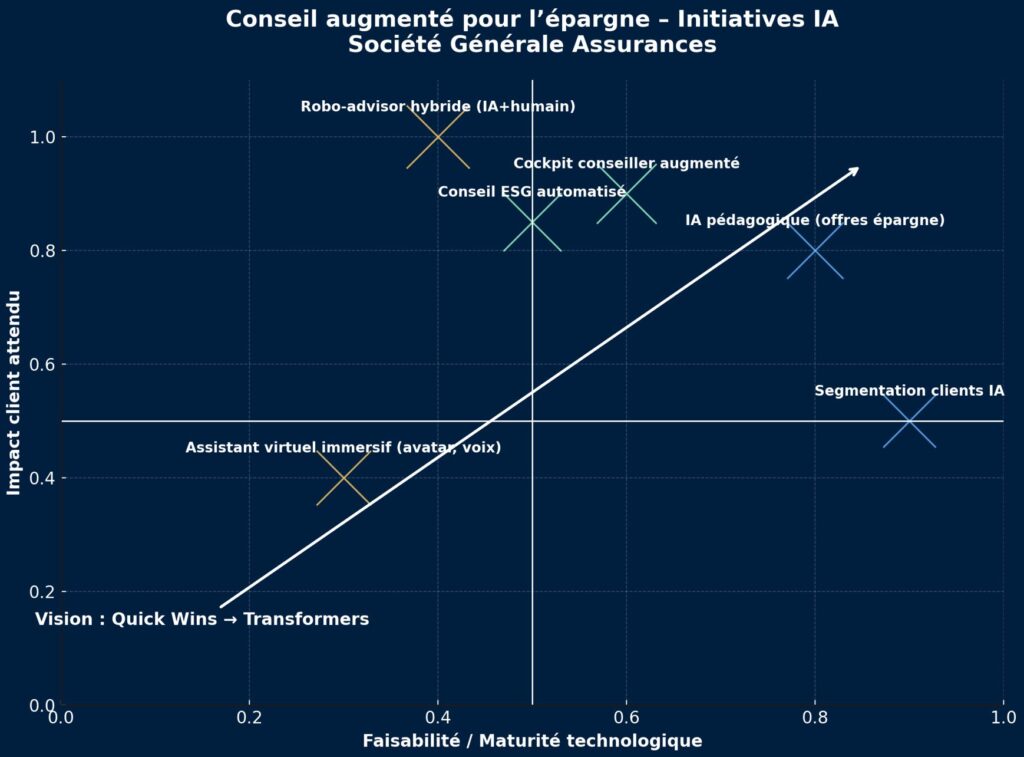
The wealth management advisor uses a hybrid robo-advisor: the AI proposes optimized asset allocations based on profile, risks and markets, then the advisor manually adjusts with a human touch.
Technologies involved:
Graph LLM to map wealth, assets and life events.
Generative LLM to create customer-readable financial scenarios.
Predictive ML to simulate yield/risk projections.
Scenario: for a senior customer, AI recommends a reallocation to less risky products, anticipating an inflationary scenario. The advisor validates and refines the strategy according to the preferences expressed.
The major language models (ChatGPT, GPT-4, etc.) are at the heart of assisted text generation, message personalization and semantic understanding.
For AI to be accurate and up-to-date, we combine a generic model with a source of contextual data (internal knowledge base, regulatory documentation).
Example: the CAPRAG pipeline uses a hybrid vector + graph RAG approach for banking customer service.
These agents can orchestrate multiple tasks autonomously, with a level of human supervision. Deloitte describes them as the next logical step behind RPA and traditional AI.
For customer scoring, churn prediction, risk assessment or fraud detection.
Leverage complex relationships between entities (customers, contracts, events) to better contextualize recommendations.
Automate the extraction of information from vouchers, contracts and PDF documents.
Marie, a customer for 8 years, has changed her situation: she wants to buy a property. Prior to the appointment, AI compiles her banking data, credit history and outstandings, and generates several loan simulations. The advisor arrives with scenarios ready to propose, optimized according to duration, amount and rate sensitivity. During the meeting, the AI suggests the addition of damage or death benefit insurance, in adapted verbatim. After the meeting, the AI automatically reminds the customer of any missing elements.
Pierre has a car policy with the insurer. During a call, the advisor receives an AI alert: the customer’s profile suggests upgrading his home cover with home automation/anti-theft options. The AI has analyzed weather data, claims history and usage (smart home). The advisor offers Pierre a relevant package, supported by the AI.
A customer submits a mortgage insurance application online. The AI automatically processes the documents (payslip, bank statements) via OCR, scans the risks, and proposes a suitable contract. The advisor intervenes only to validate atypical cases or manual adjustments, reducing the underwriting time from several days to a few hours.
AI identifies that an insured in a flood zone could benefit from a coverage upgrade or a preventive premium. The advisor receives this recommendation and proactively contacts the customer to propose an adaptation. This kind of anticipation builds trust and reduces claims.
AI models risk being perceived as “black boxes”. It is crucial to have explanatory mechanisms (XAI) and to allow the advisor to understand the logic of the suggestions.
In France and Europe, the AI / AI Act Regulation, the RGPD, non-discrimination obligations, traceability are critical points. The use of AI must remain auditable.
Banks and insurers have legacy systems (mainframe, core banking, ERP). Seamless integration with AI requires a modern architecture (API, data lake, real-time ingestion).
The advisor must embrace AI, not feel replaced. UX, training and tool design must make AI an ally, not a constraint.
AI models must be robust to adverse attacks, bias-corrected, and resilient in the event of missing or extreme data.
The paradigm of the augmented advisor marks a turning point for banking and insurance. It is no longer simply a digitization of processes, but a reconception of advisory value.
Those who know how to integrate AI – but in a reliable, explainable, trustworthy and human-centric way – will be able to offer personalized experiences on a large scale, while boosting advisor productivity.