Artificial intelligence
Transform vs. older NLP models
Transforming vs. legacy language processing models
Publiée le September 24, 2025
Transforming vs. legacy language processing models
Publiée le September 24, 2025
Central mechanism:self-attention
→ The model “looks” at all the words in parallel and learns which relationships are important, even at long distance.
Massive parallelization: no strictly sequential processing as in Recurrent Neural Networks (RNN ) → much faster training on Graphics Processing Units(GPU) and Tensor Processing Units(TPU).
Long context: handles large contextual windows (thousands of tokens), where RNN and variants lose remote memory.
Scale (scalability): scales very well (parameters, data, computation) → hence modern Large Language Models(LLMs).
Flexibility: extends to multimodal (text, image, audio), in-context learning in-context learning and efficient refinement/fine-tuning.
Limits still true on the Transformer side
Quadratic cost with context length (“classic” attention) → high memory and computation.
High data and computation requirements for very large models.
Less local inductive bias than Convolutional Neural Networks (CNN), which naturally capture local patterns.
RNN – Recurrent Neural Networks: word-by-word processing; difficulty with long-term memory(vanishing/exploding gradients).
LSTM – Long Short-Term Memory: adds gates for better memory → long the state of the art in translation and speech.
GRU – Gated Recurrent Unit: a lighter variant of the LSTM.
Seq2Seq – Sequence-to-Sequence with attention (Bahdanau/Luong): the first big leap in translation;attention is a module, not the entire architecture.
CNN/ConvS2S – Convolutional Neural Networks / Convolutional Sequence-to-Sequence: locally parallelizable, good on local patterns, less at ease with very long dependencies.
(WaveNet for audio: generative convolutional architecture).
n-gram models (counting language models),
HMM – Hidden Markov Models for sequence labeling,
CRF – Conditional Random Fields for structured labeling,
PCFG – Probabilistic Context-Free Grammars.
→ Little semantic understanding, strong feature engineering, limited performance.
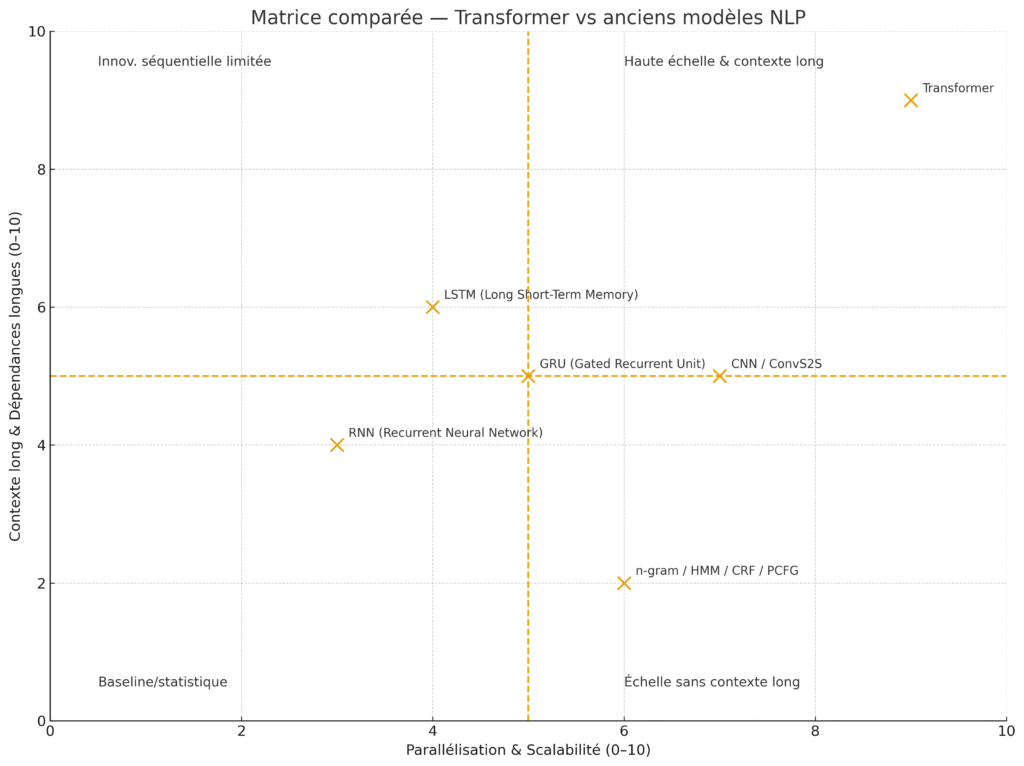
| Dimension | Transformer | RNN/LSTM/GRU | CNN/ConvS2S | n-gram/HMM/CRF/PCFG |
|---|---|---|---|---|
| Processing | Parallel (self-attention) | Sequential (recurrent hidden state) | Local parallel (filters) | Counting/statistics |
| Long outbuildings | Excellent | Difficult (gradients) | Medium | Weak |
| Drive speed | High (GPU/TPU-friendly) | Slower | High | High |
| Long context | Large window (↑ tokens) | Limited | Limited-medium | Very limited |
| LLM Scalability | Very good | Limited | Average | N/A |
| Data requirements | High | Lower | Low | Low |
| Memory/compute cost | High (attention) | Moderate | Moderate | Low |
| Local inductive bias | Weaker | – | Stronger | – |
Strong resource constraints (embedded/edge, small datasets) → GRU/LSTM remain relevant.
Dominant local patterns (small sequences, regular patterns) → CNN/ConvS2S efficient, simple and fast.
Historical labeling pipelines (little data, need for interpretability) → CRF/HMM still useful.